Several planets, like Kepler-22b, have recently been discovered that are in the habitable zones of a sun-like star. This means that the planet could have liquid water, which is necessary for life on Earth. This planet is larger than Earth, but may have pleasant surface temperatures. Still,the chances that it harbors life are slim, but there are likely many more Earth-like planets in the universe.
Extrasolar Planets or Exoplanets
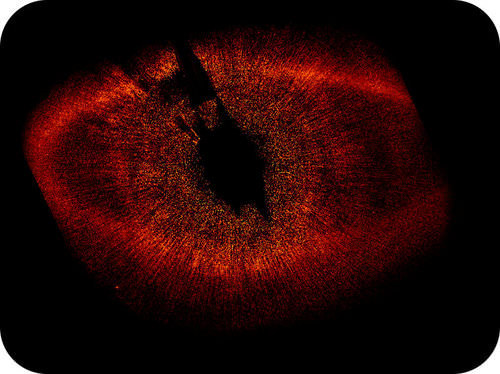
Since the early 1990s, astronomers have discovered other solar systems, with planets orbiting stars other than our own Sun. These are called "extrasolar planets" or simply exoplanets (see Figurebelow). Exoplanets are not in our solar system, but are found in other solar systems.
The extrasolar planet Fomalhaut is surrounded by a large disk of gas. The disk is not centered on the planet, suggesting that another planet may be pulling on the gas as well.
Some extrasolar planets have been directly imaged, but most have been discovered by indirect methods. One technique involves detecting the very slight motion of a star periodically moving toward and away from us along our line-of-sight (also known as a star’s "radial velocity"). This periodic motion can be attributed to the gravitational pull of a planet or, sometimes, another star orbiting the star.
A planet may also be identified by measuring a star’s brightness over time. A temporary, periodic decrease in light emitted from a star can occur when a planet crosses in front of, or "transits," the star it is orbiting, momentarily blocking out some of the starlight.
More than 1800 extrasolar planets have been identified and confirmed and the rate of discovery is increasing rapidly.
Science Friday: SciArts: Exoplanet Art
What would the sky look like from another planet? In this video by Science Friday, artist Helena Kauppila explains how she makes drawings of the night sky as seen by other planets.
Summary
Now that scientists know how to identify extrasolar planets, the numbers of confirmed examples are increasing rapidly.
An exoplanet may decrease a star's brightness as it passes in front of it.
The gravitational pull of a planet may be detected in the slight motion of a star.
Review
What is an exoplanet?
Where are exoplanets located? How are exoplanets discovered?
Why are scientists so interested in exoplanets?
Explore More
Use this resource to answer the questions that follow.
What did the Greeks think was the structure of the solar system?
What did "atomos" mean in ancient Greek and how does that word indicate what they thought of the stuff that was "out there?"
What was mission of the Kepler telescope?
As of the time this video was made how many possible exoplanets were identified? How many confirmed exoplanets?
How did the Kepler telescope identify exoplanets?
What is an Earth-like planet?
Does a planet in the habitable zone for sure have life or not have life? Why or why not?
What is the question we're really interested in?
Resources
Vocabulary
termdefinition
exoplanetshort for extrasolar planet; a planet that exists in a solar system different from our own.
Notes/Highlights
Color
Highlighted Text
Notes
Please Sign In to create your own Highlights / Notes


 FlexiA FREE Digital Tutor for Every Student
 FlexBooks 2.0Customizable, digital textbooks in a new, interactive platform
 FlexBooksCustomizable, digital textbooks
 SchoolsFlexBooks from schools and districts near you
 Study GuidesQuick review with key information for each concept
 Adaptive PracticeBuilding knowledge at each student’s skill level
 SimulationsInteractive Physics & Chemistry Simulations
 PLIXPlay. Learn. Interact. eXplore.
 CCSS MathConcepts and FlexBooks aligned to Common Core
 NGSSConcepts aligned to Next Generation Science Standards
 Certified EducatorStand out as an educator. Become CK-12 Certified.
 WebinarsLive and archived sessions to learn about CK-12