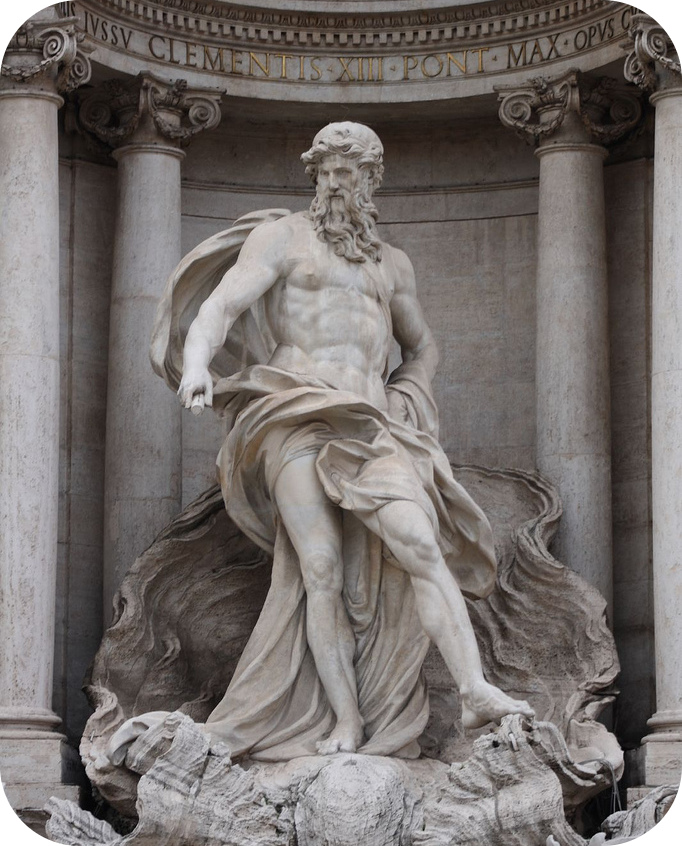
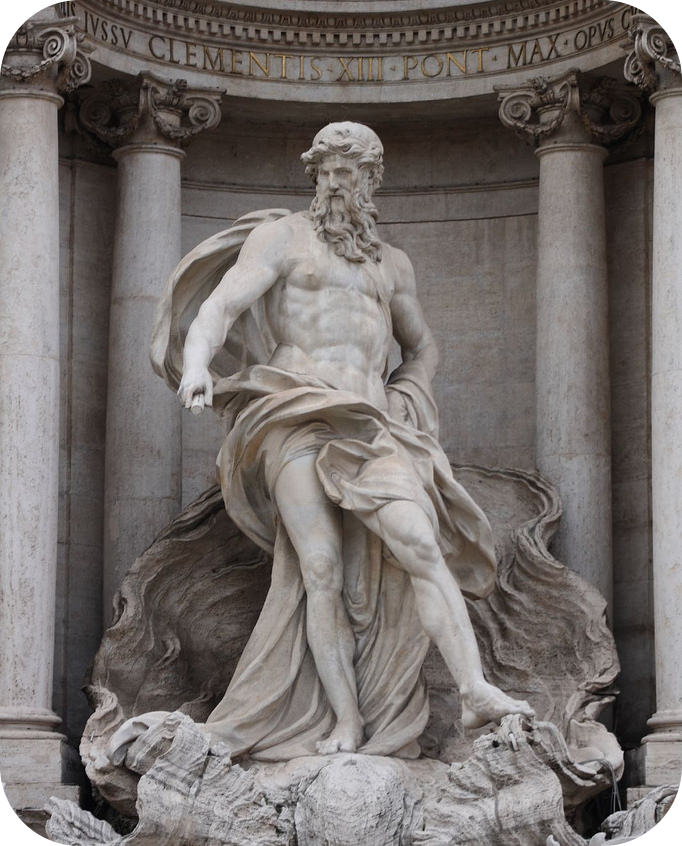
Because of its blue color, Neptune was named for the Roman god of the sea. This statue of Neptune is at the Trevi Fountain in Rome.
Neptune
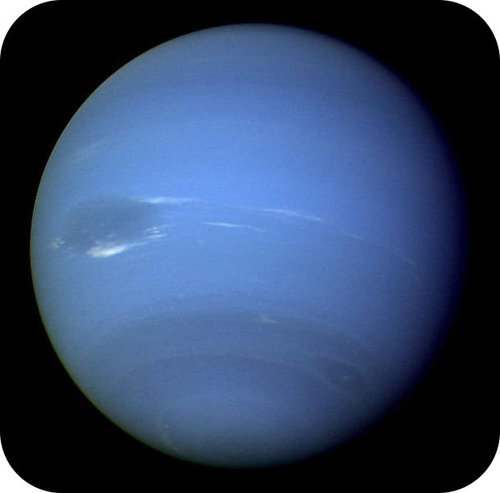
Neptune, shown in Figurebelow, is the only major planet that can’t be seen from Earth without a telescope. Scientists predicted the existence of Neptune before it was discovered because Uranus did not always appear exactly where it should appear. They knew that the gravitational pull of another planet beyond Uranus must be affecting Uranus’ orbit.
Neptune was discovered in 1846, in the position that had been predicted, and it was named Neptune for the Roman god of the sea because of its bluish color.
This image of Neptune was taken by Voyager 2 in 1989. The Great Dark Spot seen on the left center in the picture has since disappeared, but a similar dark spot has appeared on another part of the planet.
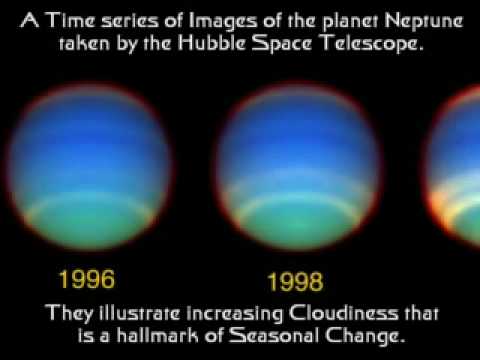
In many respects, Neptune is similar to Uranus (Figurebelow). Neptune has slightly more mass than Uranus, but it is slightly smaller in size. Neptune is much farther from the Sun, at nearly 4.5 billion km (2.8 billion mi). The planet’s slow orbit means that it takes 165 Earth years to go once around the Sun.
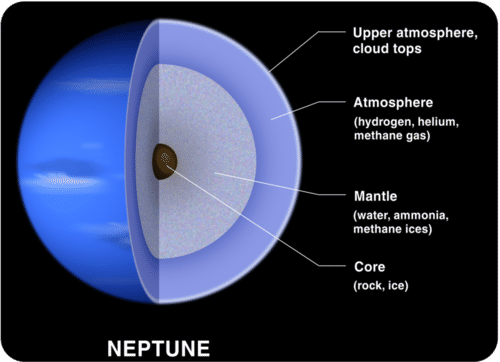
Neptune’s composition is that of a gas giant: (1) upper atmosphere, (2) atmosphere composed of hydrogen, helium and methane gas, (3) mantle of water, ammonia and methane ice, (4) core of rock and ice.
Extremes of Cold and Wind
Neptune’s blue color is mostly because of frozen methane (CH4). When Voyager 2 visited Neptune in 1986, there was a large dark-blue spot, which scientists named the Great Dark Spot, south of the equator. When the Hubble Space Telescope took pictures of Neptune in 1994, the Great Dark Spot had disappeared, but another dark spot had appeared north of the equator. Astronomers think that both of these spots represent gaps in the methane clouds on Neptune.
The changing appearance of Neptune is caused by its turbulent atmosphere. The winds on Neptune are stronger than on any other planet in the solar system, reaching speeds of 1,100 km/h (700 mi/h), close to the speed of sound. This extreme weather surprised astronomers, since the planet receives little energy from the Sun to power weather systems. Neptune's core is 7000°C (12,632°F) which means that it produces more energy than it receives from the Sun. Neptune is also one of the coldest places in the solar system. Temperatures at the top of the clouds are about -218°C (-360°F).
Neptune’s Rings and Moons
Neptune has faint rings of ice and dust that may change or disappear in fairly short time frames.
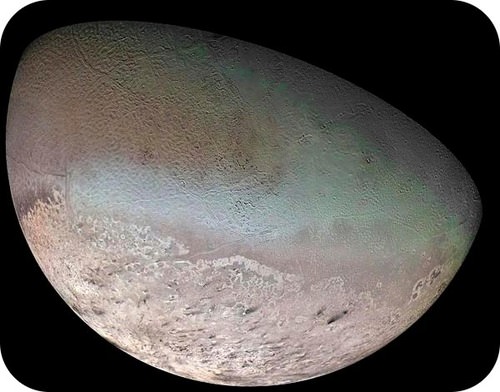
Neptune has 14 known moons. Triton, shown in Figurebelow, is the only one of them that has enough mass to be spherical in shape. Triton orbits in the direction opposite to the orbit of Neptune. Scientists think Triton did not form around Neptune, but instead was captured by Neptune’s gravity as it passed by.
This image of Triton, Neptune’s largest moon, was taken by Voyager 2 in 1989.
Summary
Neptune is so far from Earth that it can't be seen without a telescope.
Neptune has a turbulent atmosphere, which changes the planet's appearance. The blue color is due to frozen methane.
Neptune has 13 moons, including Triton, which orbits in the opposite direction from Neptune.
Review
Why did scientists think that there was a planet beyond Uranus before it had been identified as a planet in a telescope?
Describe the moons of Neptune and where they originated.
What causes the dark spots in Neptune's appearance? Why do they come and go?
Explore More
Use this resource to answer the questions that follow.
How was Neptune found?
What is the structure of Neptune?
What is the atmosphere composed of? Why is Neptune blue?
What is the atmosphere of Neptune like?
What causes the intense winds on Neptune? Why aren't the winds caused by the Sun?
How long is a season on Neptune?
What is Triton? What is unusual about it?
What is the probably origin of Neptune's rings?
Why do we know so little about Neptune?
Notes/Highlights
Color
Highlighted Text
Notes
Please Sign In to create your own Highlights / Notes


 FlexiA FREE Digital Tutor for Every Student
 FlexBooks 2.0Customizable, digital textbooks in a new, interactive platform
 FlexBooksCustomizable, digital textbooks
 SchoolsFlexBooks from schools and districts near you
 Study GuidesQuick review with key information for each concept
 Adaptive PracticeBuilding knowledge at each student’s skill level
 SimulationsInteractive Physics & Chemistry Simulations
 PLIXPlay. Learn. Interact. eXplore.
 CCSS MathConcepts and FlexBooks aligned to Common Core
 NGSSConcepts aligned to Next Generation Science Standards
 Certified EducatorStand out as an educator. Become CK-12 Certified.
 WebinarsLive and archived sessions to learn about CK-12