"I have not as yet been able to discover the reason for these properties of gravity from phenomena, and I do not feign hypotheses." - Isaac Newton, in Philosophiae Naturalis Principia Mathematica, 1687.
The Role of Gravity
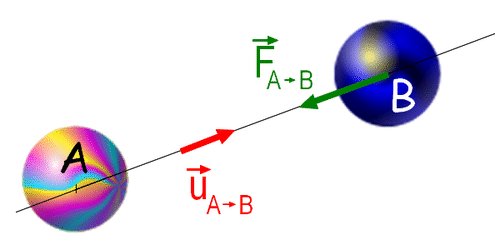
Isaac Newton first described gravity as the force that causes objects to fall to the ground and also the force that keeps the Moon circling Earth instead of flying off into space in a straight line. Newton defined the Universal Law of Gravitation, which states that a force of attraction, called gravity, exists between all objects in the universe (Figurebelow). The strength of the gravitational force depends on how much mass the objects have and how far apart they are from each other. The greater the objects' mass, the greater the force of attraction; in addition, the greater the distance between objects, the smaller the force of attraction.
The force of gravity exists between all objects in the universe; the strength of the force depends on the mass of the objects and the distance between them.
The distance between the Sun and each of its planets is very large, but the Sun and each of the planets are also very large. Gravity keeps each planet orbiting the Sun because the star and its planets are very large objects. The force of gravity also holds moons in orbit around planets.
Summary
Newton developed the Universal Law of Gravitation, which recognizes the gravitational attraction between objects.
All objects have a force of attraction between them that is proportional to their mass and distance from each other.
Gravity keeps the planets orbiting the Sun because they are very large, just as gravity keeps satellites orbiting the planets.
Review
Why is the gravitational attraction of the Moon to Earth greater than the attraction of Earth to Sun?
Why doesn't the Moon fly off into space? Why does an apple fall to the ground rather than orbiting Earth at a distance?
What is the Universal Law of Gravitation?
Explore More
Use this resource to answer the questions that follow.
How long have the Earth and Moon existed?
What evidence shows that the Moon's gravity affects the Earth?
What does Newton's law of gravitation state?
What happens as mass increases?
What happens as distance increases?
Vocabulary
termdefinition
gravityforce of attraction that exists between all massive objects in the universe.
Notes/Highlights
Color
Highlighted Text
Notes
Please Sign In to create your own Highlights / Notes


 FlexiA FREE Digital Tutor for Every Student
 FlexBooks 2.0Customizable, digital textbooks in a new, interactive platform
 FlexBooksCustomizable, digital textbooks
 SchoolsFlexBooks from schools and districts near you
 Study GuidesQuick review with key information for each concept
 Adaptive PracticeBuilding knowledge at each student’s skill level
 SimulationsInteractive Physics & Chemistry Simulations
 PLIXPlay. Learn. Interact. eXplore.
 CCSS MathConcepts and FlexBooks aligned to Common Core
 NGSSConcepts aligned to Next Generation Science Standards
 Certified EducatorStand out as an educator. Become CK-12 Certified.
 WebinarsLive and archived sessions to learn about CK-12