"Accordingly, since nothing prevents the earth from moving...
...I suggest that we should now consider also whether several motions suit it, so that it can be regarded as one of the planets. For, it is not the center of all the revolutions." - Nicolaus Copernicus
The Size and Shape of Orbits
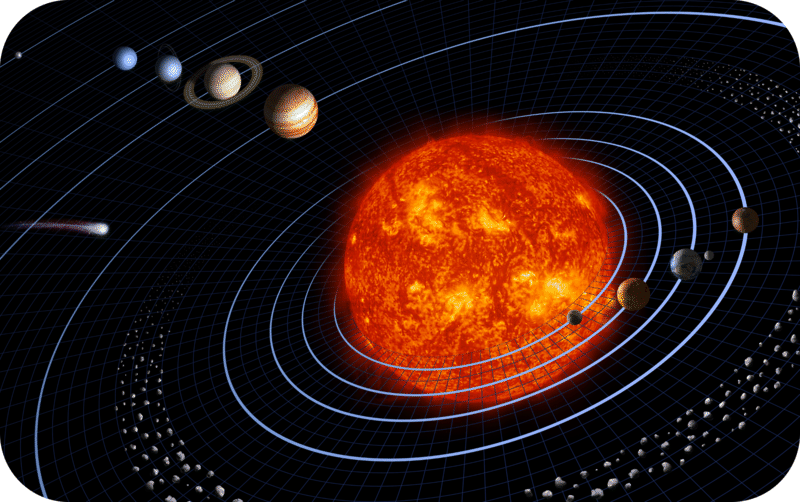
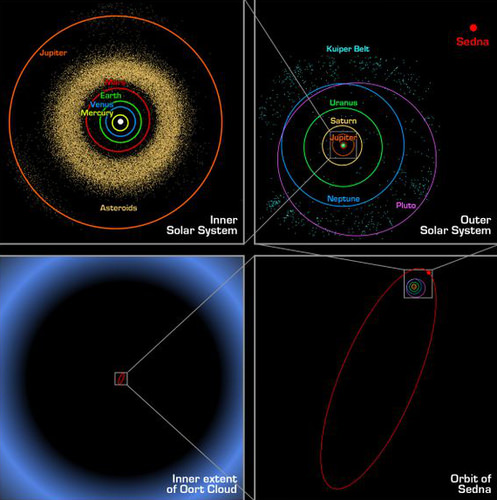
Figurebelow shows the relative sizes of the orbits of the planets, asteroid belt, and Kuiper belt. In general, the farther away from the Sun, the greater the distance from one planet’s orbit to the next. The orbits of the planets are not circular but slightly elliptical, with the Sun located at one of the foci (see opening image).
The relative sizes of the orbits of planets in the solar system. The inner solar system and asteroid belt is on the upper left. The upper right shows the outer planets and the Kuiper belt.
While studying the solar system, Johannes Kepler discovered the relationship between the time it takes a planet to make one complete orbit around the Sun, its "orbital period," and the distance from the Sun to the planet. If the orbital period of a planet is known, then it is possible to determine the planet’s distance from the Sun. This is how astronomers without modern telescopes could determine the distances to other planets within the solar system.
How old are you on Earth? How old would you be if you lived on Jupiter? How many days is it until your birthday on Earth? How many days until your birthday if you lived on Saturn?
Summary
The eight planets orbit the Sun along slightly elliptical paths, with Sun located at one of the foci.
Kepler discovered that by using a planet's orbital period, it is possible to determine its distance from the Sun.
The farther the planets are from the Sun, the greater their distance from each other.
Review
When you look at the diagram of planet orbits, which planetoid (planet-like object) doesn't fit the criteria of a planet?
How did Johannes Kepler determine a planet's distance from the Sun?
Why would your age - the number of orbits you have made around the Sun - be different on a different planet? Would you be younger or older?
NOTES / HIGHLIGHTS
Please Sign In to create your own Highlights / Notes
Notes/Highlights
Color
Highlighted Text
Notes
Please Sign In to create your own Highlights / Notes


 FlexiA FREE Digital Tutor for Every Student
 FlexBooks 2.0Customizable, digital textbooks in a new, interactive platform
 FlexBooksCustomizable, digital textbooks
 SchoolsFlexBooks from schools and districts near you
 Study GuidesQuick review with key information for each concept
 Adaptive PracticeBuilding knowledge at each student’s skill level
 SimulationsInteractive Physics & Chemistry Simulations
 PLIXPlay. Learn. Interact. eXplore.
 CCSS MathConcepts and FlexBooks aligned to Common Core
 NGSSConcepts aligned to Next Generation Science Standards
 Certified EducatorStand out as an educator. Become CK-12 Certified.
 WebinarsLive and archived sessions to learn about CK-12