If the universe is expanding, the next logical thought is that in the past it had to have been smaller. A point even. The time when the universe began is the explosion known as the Big Bang.
The Big Bang Theory
Timeline of the Big Bang and the expansion of the Universe.
The Big Bang theory is the most widely accepted cosmological explanation of how the universe formed. If we start at the present and go back into the past, the universe is contracting — getting smaller and smaller. What is the end result of a contracting universe?
According to the Big Bang theory, the universe began about 13.7 billion years ago. Everything that is now in the universe was squeezed into a very small volume. Imagine all of the known universe in a single, hot, chaotic mass. An enormous explosion — a big bang — caused the universe to start expanding rapidly. All the matter and energy in the universe, and even space itself, came out of this explosion.
What came before the Big Bang? There is no way for scientists to know since there is no remaining evidence.
After The Big Bang
In the first few moments after the Big Bang, the universe was unimaginably hot and dense. As the universe expanded, it became less dense and began to cool. After only a few seconds, protons, neutrons, and electrons could form. After a few minutes, those subatomic particles came together to create hydrogen. Energy in the universe was great enough to initiate nuclear fusion, and hydrogen nuclei were fused into helium nuclei. The first neutral atoms that included electrons did not form until about 380,000 years later.
The matter in the early universe was not smoothly distributed across space. Dense clumps of matter held close together by gravity were spread around. Eventually, these clumps formed countless trillions of stars, billions of galaxies, and other structures that now form most of the visible mass of the universe.
If you look at an image of galaxies at the far edge of what we can see, you are looking at great distances. But you are also looking across a different type of distance. What do those far away galaxies represent? Because it takes so long for light from so far away to reach us, you are also looking back in time (Figurebelow).
Images from very far away show what the universe was like not too long after the Big Bang.
Background Radiation
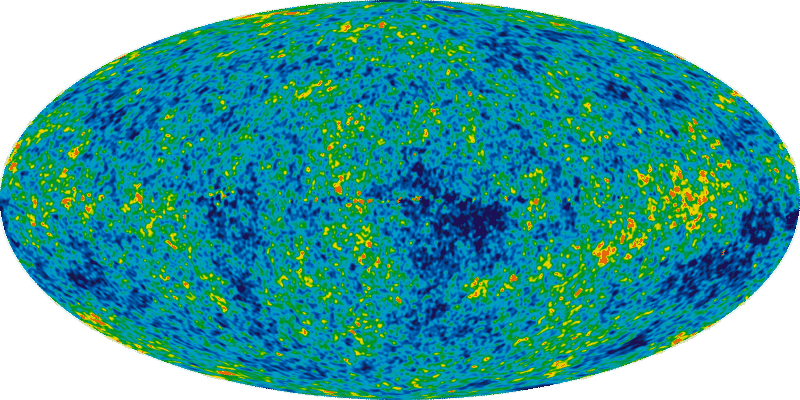
After the origin of the Big Bang hypothesis, many astronomers still thought the universe was static. Nearly all came around when an important line of evidence for the Big Bang was discovered in 1964. In a static universe, the space between objects should have no heat at all; the temperature should measure 0 K (Kelvin is an absolute temperature scale). But two researchers at Bell Laboratories used a microwave receiver to learn that the background radiation in the universe is not 0 K, but 3 K (Figurebelow). This tiny amount of heat is left over from the Big Bang. Since nearly all astronomers now accept the Big Bang hypothesis, what is it usually referred to as?
Background radiation in the universe was good evidence for the Big Bang theory.
Science Friday: How to Make Quark Soup
What is a quark soup? Why is understanding a quark soup important to understanding the early universe? In this video by Science Friday, physicist Paul Sorensen explains what a quark soup is and some of the information it tells us about the early universe.
Summary
The Big Bang theory states that the universe began as a point and expanded outward.
No one can know what came before the Big Bang because there is no remaining evidence.
The tiny bit of background radiation in the universe is energy remaining from the Big Bang.
Review
How is the idea that the universe started in a big bang a logical extension from a fact?
What evidence is there that the universe began in a big bang?
What happened in the first minutes after the Big Bang?
Resources
Notes/Highlights
Color
Highlighted Text
Notes
Please Sign In to create your own Highlights / Notes


 FlexiA FREE Digital Tutor for Every Student
 FlexBooks 2.0Customizable, digital textbooks in a new, interactive platform
 FlexBooksCustomizable, digital textbooks
 SchoolsFlexBooks from schools and districts near you
 Study GuidesQuick review with key information for each concept
 Adaptive PracticeBuilding knowledge at each student’s skill level
 SimulationsInteractive Physics & Chemistry Simulations
 PLIXPlay. Learn. Interact. eXplore.
 CCSS MathConcepts and FlexBooks aligned to Common Core
 NGSSConcepts aligned to Next Generation Science Standards
 Certified EducatorStand out as an educator. Become CK-12 Certified.
 WebinarsLive and archived sessions to learn about CK-12