It's not hot in temperature; it's a hot topic in cosmology. Many lines of evidence support the Big Bang theory for explaining the formation of the universe. However, scientists are now wrestling with some unanswered questions about what the universe is made of and why it is expanding.
Dark Matter
The things we observe in space are objects that emit some type of electromagnetic radiation. However, scientists think that matter that emits light makes up only a small part of the matter in the universe. The rest of the matter, about 80%, is dark matter.
Dark matter emits no electromagnetic radiation, so we can’t observe it directly. However, astronomers know that dark matter exists because its gravity affects the motion of objects around it. When astronomers measure how spiral galaxies rotate, they find that the outside edges of a galaxy rotate at the same speed as parts closer to the center. This can only be explained if there is a lot more matter in the galaxy than they can see.
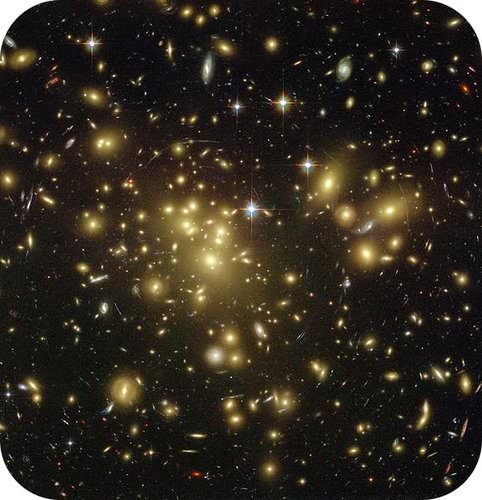
Gravitational lensing occurs when light is bent from a very distant bright source around a super-massive object (Figurebelow). To explain strong gravitational lensing, more matter than is observed must be present.
The arc around the galaxies at the center of this image is caused by gravitational lensing. The addition of gravitational pull from dark matter is required to explain this phenomenon.
With so little to go on, astronomers don’t really know much about the nature of dark matter. One possibility is that it could just be ordinary matter that does not emit radiation in objects such as black holes, neutron stars, and brown dwarfs — objects larger than Jupiter but smaller than the smallest stars. But astronomers cannot find enough of these types of objects, which they have named MACHOs (massive astrophyiscal compact halo object), to account for all the dark matter, so they are thought to be only a small part of the total.
Another possibility is that the dark matter is very different from the ordinary matter we see. Some appear to be particles that have gravity, but don’t otherwise appear to interact with other particles. Scientists call these theoretical particles WIMPs, which stands for Weakly Interactive Massive Particles.
Most scientists who study dark matter think that the dark matter in the universe is a combination of MACHOs and some type of exotic matter, such as WIMPs. Researching dark matter is an active area of scientific research, and astronomers’ knowledge about dark matter is changing rapidly.
Dark Energy
Astronomers who study the expansion of the universe are interested in knowing the rate of that expansion. Is the rate fast enough to overcome the attractive pull of gravity?
If yes, then the universe will expand forever, although the expansion will slow down over time.
If no, then the universe would someday start to contract, and eventually get squeezed together in a big crunch, the opposite of the Big Bang.
Recently, astronomers have made a discovery that answers that question: the rate at which the universe is expanding is actually increasing. In other words, the universe is expanding faster now than ever before, and in the future it will expand even faster. So now astronomers think that the universe will keep expanding forever. But it also proposes a perplexing new question: what is causing the expansion of the universe to accelerate?
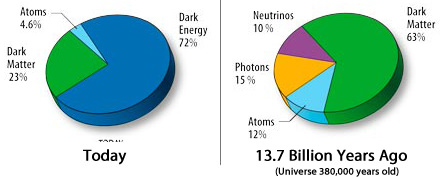
One possible hypothesis involves a new, hypothetical form of energy called dark energy (Figurebelow). Some scientists think that dark energy makes up as much as 71% of the total energy content of the universe.
Today matter makes up a small percentage of the universe, but at the start of the universe it made up much more. Where did dark energy, if it even exists, come from?
Other scientists have other hypotheses about why the universe is continuing to expand; the causes of the universe’s expansion is another unanswered question that scientists are researching.
KQED: Dark Energy
Meet one of the three winners of the 2011 Nobel Prize in Physics, Lawrence Berkeley Lab astrophysicist Saul Perlmutter. He explains how dark energy, which makes up 70 percent of the universe, is causing our universe to expand.
ScienceFriday: 4850 Feet Below: The Hunt for Dark Matter
Why is there a laboratory 4850 feet below the surface? It turns out the depth is a necessary component of the extremely sensitive detector called the Large Underground Xenon experiment. In this video by ScienceFriday, several scientists explain how this detector helps physicists look for extremely rare particles.
Summary
Dark matter cannot be sensed by astronomers, but the effect of its gravity is seen on the motion of nearby objects.
Dark matter may be a combination of WIMPs and MACHOs.
Dark energy is still hypothetical, but if it exists it could be a significant portion of the energy of the universe.
Review
Why can't scientists see dark matter? Since they can't see it, how do they know that it exists?
What are WIMPs and MACHOs and why are they important?
What might dark energy be and why is it important?
Resources
NOTES / HIGHLIGHTS
Please Sign In to create your own Highlights / Notes
Vocabulary
termdefinition
dark energyan as yet undiscovered form of energy that we cannot see.
dark mattermatter in the universe that doesn't emit light.
Notes/Highlights
Color
Highlighted Text
Notes
Please Sign In to create your own Highlights / Notes
Credit:Courtesy of NASA, N. Benitez (JHU), T. Broadhurst (Racah Institute of Physics/The Hebrew University), H. Ford (JHU), M. Clampin (STScI),G. Hartig (STScI), G. Illingworth (UCO/Lick Observatory), the ACS Science Team and ESA Source:http://commons.wikimedia.org/wiki/File:Gravitationell-lins-4.jpg License:Public Domain


 FlexiA FREE Digital Tutor for Every Student
 FlexBooks 2.0Customizable, digital textbooks in a new, interactive platform
 FlexBooksCustomizable, digital textbooks
 SchoolsFlexBooks from schools and districts near you
 Study GuidesQuick review with key information for each concept
 Adaptive PracticeBuilding knowledge at each student’s skill level
 SimulationsInteractive Physics & Chemistry Simulations
 PLIXPlay. Learn. Interact. eXplore.
 CCSS MathConcepts and FlexBooks aligned to Common Core
 NGSSConcepts aligned to Next Generation Science Standards
 Certified EducatorStand out as an educator. Become CK-12 Certified.
 WebinarsLive and archived sessions to learn about CK-12