Marilyn Monroe was a famous movie star, even a superstar. Movie stars shine brightly — and in some cases, as with Marilyn, die young. Stars also shine brightly, then die. Their power, like that of an atom bomb, comes from nuclear fusion.
Star Power
The Sun is Earth’s major source of energy, yet the planet only receives a small portion of its energy. The Sun is just an ordinary star. Many stars produce much more energy than the Sun. The energy source for all stars is nuclear fusion.
Nuclear Fusion
Stars are made mostly of hydrogen and helium, which are packed so densely in a star that in the star’s center the pressure is great enough to initiate nuclear fusion reactions. In a nuclear fusion reaction, the nuclei of two atoms combine to create a new atom. Most commonly, in the core of a star, two hydrogen atoms fuse to become a helium atom. Although nuclear fusion reactions require a lot of energy to get started, once they are going they produce enormous amounts of energy (Figurebelow).
A thermonuclear bomb is an uncontrolled fusion reaction in which enormous amounts of energy are released.
In a star, the energy from fusion reactions in the core pushes outward to balance the inward pull of gravity. This energy moves outward through the layers of the star until it finally reaches the star’s outer surface. The outer layer of the star glows brightly, sending the energy out into space as electromagnetic radiation, including visible light, heat, ultraviolet light, and radio waves (Figurebelow).
A diagram of a star like the Sun.
Particle Accelerators
In particle accelerators, subatomic particles are propelled until they have attained almost the same amount of energy as found in the core of a star (Figurebelow). When these particles collide head-on, new particles are created. This process simulates the nuclear fusion that takes place in the cores of stars. The process also simulates the conditions that allowed for the first helium atom to be produced from the collision of two hydrogen atoms in the first few minutes of the universe.
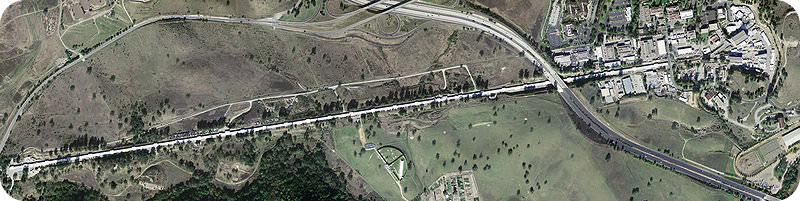
The SLAC National Accelerator Lab in California can propel particles a straight 2 mi (3.2 km).
The CERN Particle Accelerator presented in this video is the world's largest and most powerful particle accelerator. The accelerator can boost subatomic particles to energy levels that simulate conditions in the stars and in the early history of the universe before stars formed.
Summary
In a nuclear fusion reaction, two nuclei combine to form a larger nucleus.
The energy from fusion reactions keeps the star from collapsing from its own gravity.
Particle accelerators simulate reactions at the cores of stars.
Review
What type of fusion reaction takes place in most stars?
What do scientists learn from particle accelerators?
Why don't stars collapse on themselves?
Explore More
Use this resource to answer the questions that follow.
What are stars made up of at the beginning?
What happens during hydrogen fusion? What does this release?
What occurs when the star runs out of hydrogen?
How does it make heavier elements from helium? What are these elements the building blocks of?
What is the last element created in a star? Why?
When does a star die?
What does a supernova create?
Notes/Highlights
Color
Highlighted Text
Notes
Please Sign In to create your own Highlights / Notes


 FlexiA FREE Digital Tutor for Every Student
 FlexBooks 2.0Customizable, digital textbooks in a new, interactive platform
 FlexBooksCustomizable, digital textbooks
 SchoolsFlexBooks from schools and districts near you
 Study GuidesQuick review with key information for each concept
 Adaptive PracticeBuilding knowledge at each student’s skill level
 SimulationsInteractive Physics & Chemistry Simulations
 PLIXPlay. Learn. Interact. eXplore.
 CCSS MathConcepts and FlexBooks aligned to Common Core
 NGSSConcepts aligned to Next Generation Science Standards
 Certified EducatorStand out as an educator. Become CK-12 Certified.
 WebinarsLive and archived sessions to learn about CK-12