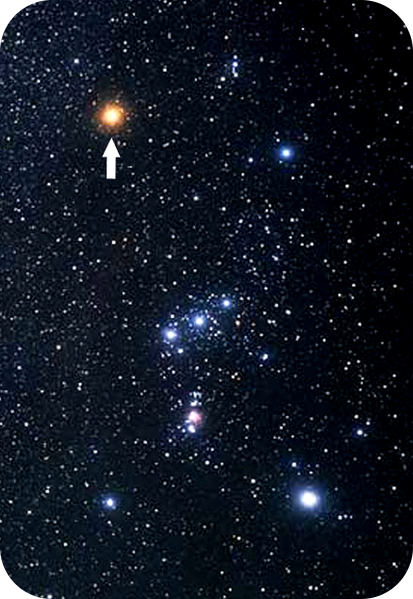
Why are the stars in Orion's Belt different colors?
The ancient Greeks thought this group of stars looked like a hunter, so they named it Orion after their mythical hunter. The line of three stars at the center is "Orion's Belt." The many different colors of stars reflect the star’s temperature. The bright, red star in the upper left (with an arrow pointing to it), named Betelgeuse (pronounced BET-ul-juice), is not as hot than the blue star in the lower right, named Rigel.
Color and Temperature
Think about how the color of a piece of metal changes with temperature. A coil of an electric stove will start out black, but with added heat will start to glow a dull red. With more heat, the coil turns a brighter red, then orange. At extremely high temperatures the coil will turn yellow-white, or even blue-white (it’s hard to imagine a stove coil getting that hot). A star’s color is also determined by the temperature of the star’s surface. Relatively cool stars are red, warmer stars are orange or yellow, and extremely hot stars are blue or blue-white (Figurebelow).
A Hertzsprung-Russell diagram shows the brightness and color of main sequence stars. The brightness is indicated by luminosity and is higher up the y-axis. The temperature is given in degrees Kelvin and is higher on the left side of the x-axis. How does our Sun fare in terms of brightness and color compared with other stars?
Classifying Stars by Color
Color is the most common way to classify stars. Tablebelow shows the classification system. The class of a star is given by a letter. Each letter corresponds to a color, and also to a range of temperatures. Note that these letters don’t match the color names; they are left over from an older system that is no longer used.


 FlexiA FREE Digital Tutor for Every Student
 FlexBooks 2.0Customizable, digital textbooks in a new, interactive platform
 FlexBooksCustomizable, digital textbooks
 SchoolsFlexBooks from schools and districts near you
 Study GuidesQuick review with key information for each concept
 Adaptive PracticeBuilding knowledge at each student’s skill level
 SimulationsInteractive Physics & Chemistry Simulations
 PLIXPlay. Learn. Interact. eXplore.
 CCSS MathConcepts and FlexBooks aligned to Common Core
 NGSSConcepts aligned to Next Generation Science Standards
 Certified EducatorStand out as an educator. Become CK-12 Certified.
 WebinarsLive and archived sessions to learn about CK-12