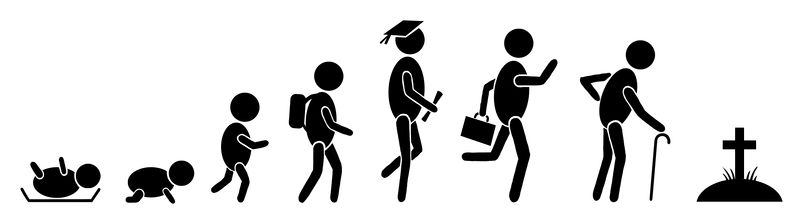
Stars have a life cycle, just like people: they are born, grow, change over time, and eventually grow old and die. Most stars change in size, color, and class at least once in their lifetime. What astronomers know about the life cycles of stars is because of data gathered from visual, radio, and X-ray telescopes.
Star Formation
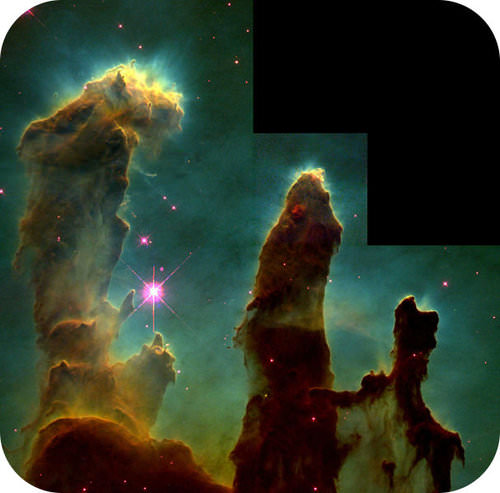
As discussed in the chapter The Solar System, stars are born in clouds of gas and dust called nebulas, like the one shown in Figurebelow.
The Pillars of Creation within the Eagle Nebula are where gas and dust come together as a stellar nursery.
The Main Sequence
Hertzsprung-Russel diagram.
For most of a star’s life, nuclear fusion in the core produces helium from hydrogen. A star in this stage is a main sequence star. This term comes from the Hertzsprung-Russell diagram shown in the Figureabove. For stars on the main sequence, temperature is directly related to brightness. A star is on the main sequence as long as it is able to balance the inward force of gravity with the outward force of nuclear fusion in its core. The more massive a star, the more it must burn hydrogen fuel to prevent gravitational collapse. Because they burn more fuel, more massive stars have higher temperatures. Massive stars also run out of hydrogen sooner than smaller stars do.
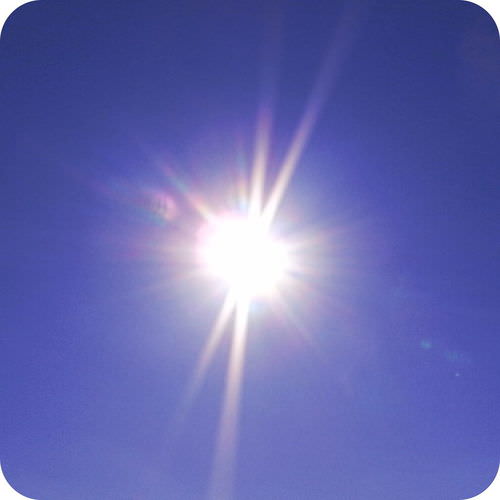
Our Sun has been a main sequence star for about 5 billion years and will continue on the main sequence for about 5 billion more years (Figurebelow). Very large stars may be on the main sequence for only 10 million years. Very small stars may last tens to hundreds of billions of years.
Our Sun is a medium-sized star in about the middle of its main sequence life.
Red Giants and White Dwarfs
As a star begins to use up its hydrogen, it fuses helium atoms together into heavier atoms such as carbon. A blue giant star has exhausted its hydrogen fuel and is in a transitional phase. When the light elements are mostly used up, the star can no longer resist gravity and starts to collapse inward. The outer layers of the star grow outward and cool. The larger, cooler star turns red in color and so is called a red giant.
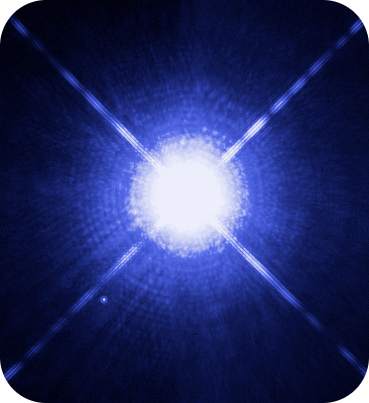
Eventually, a red giant burns up all of the helium in its core. What happens next depends on how massive the star is. A typical star, such as the Sun, stops fusion completely. Gravitational collapse shrinks the star's core to a white, glowing object about the size of Earth, called a white dwarf (Figurebelow). A white dwarf will ultimately fade out.
Sirius, the brightest star in the sky, is actually a binary star system. Sirius A is on the main sequence. Sirius B, the tiny dot on the lower left, is a white dwarf.
Supergiants and Supernovas
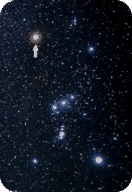
A star that runs out of helium will end its life much more dramatically. When very massive stars leave the main sequence, they become red supergiants (Figurebelow).
The red star Betelgeuse in Orion is a red supergiant.
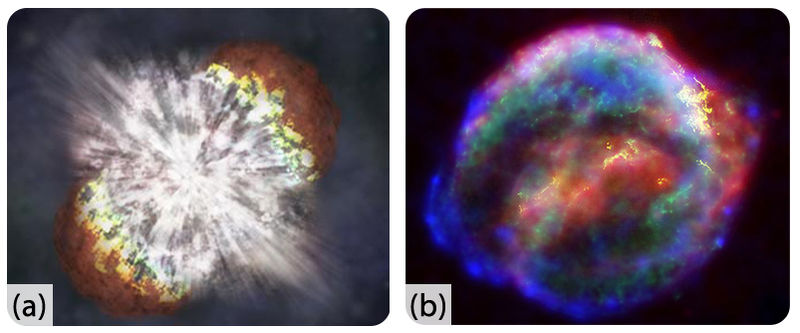
Unlike a red giant, when all the helium in a red supergiant is gone, fusion continues. Lighter atoms fuse into heavier atoms up to iron atoms. Creating elements heavier than iron through fusion uses more energy than it produces, so stars do not ordinarily form any heavier elements. When there are no more elements for the star to fuse, the core succumbs to gravity and collapses, creating a violent explosion called a supernova (Figurebelow). A supernova explosion contains so much energy that atoms can fuse together to produce heavier elements such as gold, silver, and uranium. A supernova can shine as brightly as an entire galaxy for a short time. All elements with an atomic number greater than that of lithium were formed by nuclear fusion in stars.
(a) NASA’s Chandra X-ray observatory captured the brightest stellar explosion so far, 100 times more energetic than a typical supernova. (b) This false-color image of the supernova remnant SN 1604 was observed as a supernova in the Milky Way galaxy. At its peak it was brighter than all other stars and planets, except Venus, in the night sky.
Neutron Stars
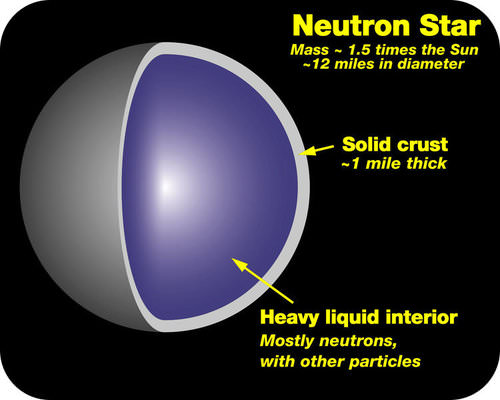
After a supernova explosion, the leftover material in the core is extremely dense. If the core is less than about four times the mass of the Sun, the star becomes a neutron star (Figurebelow). A neutron star is more massive than the Sun, but only a few kilometers in diameter. A neutron star is made almost entirely of neutrons, relatively large particles that have no electrical charge.
After a supernova, the remaining core may end up as a neutron star.
Black Hole
If the core remaining after a supernova is more than about five times the mass of the Sun, the core collapses into a black hole. Black holes are so dense that not even light can escape their gravity. With no light, a black hole cannot be observed directly. But a black hole can be identified by the effect that it has on objects around it, and by radiation that leaks out around its edges.
Summary
Stars spend most of their lives on the main sequence, fusing hydrogen into helium for energy.
As stars burn up their hydrogen and fuse helium into larger atoms they begin to collapse and become red giants. When the helium is gone they become white dwarfs.
When a massive star has no more elements left to fuse it explodes as a supernova, from which the chemical elements heavier than lithium form.
An extremely massive core will collapse after a supernova explosion to become a black hole, which is black because no light can escape it.
Review
Why do some stars become red giants and others become supernovae?
Why are supernovae crucial to the evolution of the universe?
How does a star become a black hole? What are the characteristics of a black hole?
Resources
Vocabulary
termdefinition
black holea region of space from which gravity prevents anything, including light, from escaping.
main sequence stara star that is fusing hydrogen atoms to helium; a star in the main portion of its “life.”.
neutron starthe remnant of a massive star after it explodes as a supernova.
red giantstage in a star's development when the inner helium core contracts while the outer layers of hydrogen expand, producing a very large red star.
supernovaa tremendous explosion that occurs when the core of a star is mostly iron.
white dwarfa small to mid-sized star that has collapsed.
Notes/Highlights
Color
Highlighted Text
Notes
Please Sign In to create your own Highlights / Notes

 FlexiA FREE Digital Tutor for Every Student
 FlexBooks 2.0Customizable, digital textbooks in a new, interactive platform
 FlexBooksCustomizable, digital textbooks
 SchoolsFlexBooks from schools and districts near you
 Study GuidesQuick review with key information for each concept
 Adaptive PracticeBuilding knowledge at each student’s skill level
 SimulationsInteractive Physics & Chemistry Simulations
 PLIXPlay. Learn. Interact. eXplore.
 CCSS MathConcepts and FlexBooks aligned to Common Core
 NGSSConcepts aligned to Next Generation Science Standards
 Certified EducatorStand out as an educator. Become CK-12 Certified.
 WebinarsLive and archived sessions to learn about CK-12