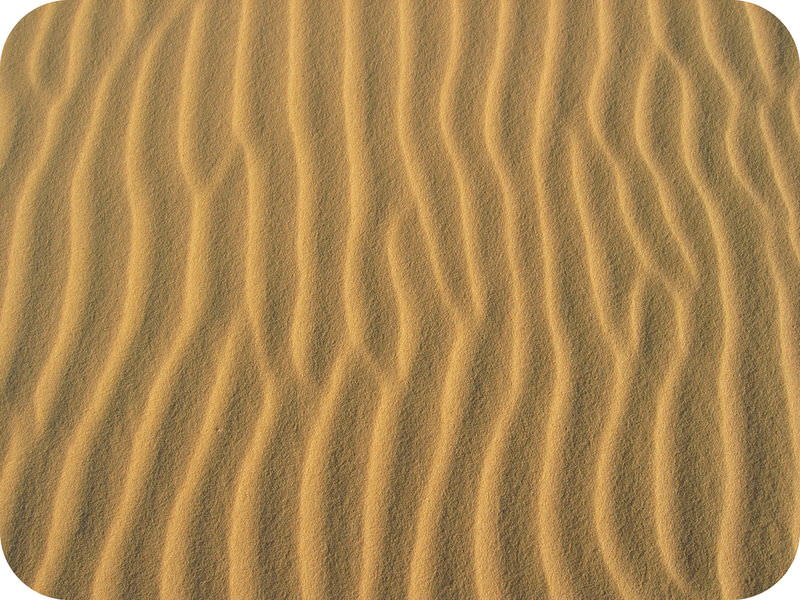
What is this material and what created the ripples?
If you've walked on a sandy beach or on a sand dune, you may have seen ripples like this formed from wind or waves. Sand is small broken pieces of rock that can be moved around. They can also be lithified to become a rock known as sandstone.
Sediments
Sandstone is one of the common types of sedimentary rocks that form from sediments. There are many other types. Sediments may include:
fragments of other rocks that often have been worn down into small pieces, such as sand, silt, or clay.
organic materials, or the remains of once-living organisms.
chemical precipitates, which are materials that get left behind after the water evaporates from a solution.
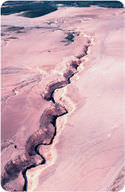
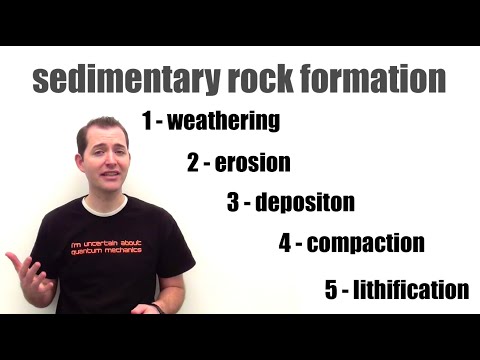
Rocks at the surface undergo mechanical and chemical weathering. These physical and chemical processes break rock into smaller pieces. Mechanical weathering simply breaks the rocks apart. Chemical weathering dissolves the less stable minerals. These original elements of the minerals end up in solution and new minerals may form. Sediments are removed and transported by water, wind, ice, or gravity in a process called erosion (Figurebelow). Much more information about weathering and erosion can be found in the chapter Surface Processes and Landforms.
Water erodes the land surface in Alaska’s Valley of Ten Thousand Smokes.
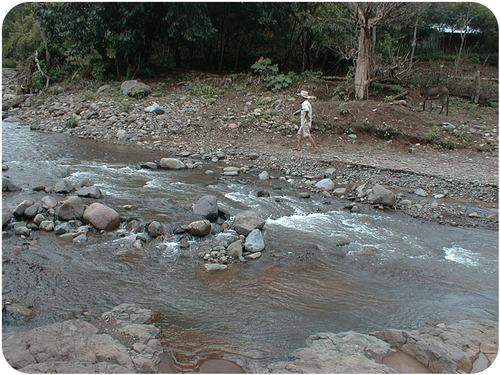
Streams carry huge amounts of sediment (Figurebelow). The more energy the water has, the larger the particle it can carry. A rushing river on a steep slope might be able to carry boulders. As this stream slows down, it no longer has the energy to carry large sediments and will drop them. A slower moving stream will only carry smaller particles.
A river dumps sediments along its bed and on its banks.
Sediments are deposited on beaches and deserts, at the bottom of oceans, and in lakes, ponds, rivers, marshes, and swamps. Landslides drop large piles of sediment. Glaciers leave large piles of sediments, too. Wind can only transport sand and smaller particles. The type of sediment that is deposited will determine the type of sedimentary rock that can form. Different colors of sedimentary rock are determined by the environment where they are deposited. Red rocks form where oxygen is present. Darker sediments form when the environment is oxygen poor.
Summary
Rocks undergo chemical or mechanical weathering to form smaller pieces.
Sediments range in size from tiny bits of silt or clay to enormous boulders.
Sediments are transported by wind, water, ice, or gravity into different environments.
Review
What does sediment size indicate about the history of that depositional environment?
How are chemical precipitates different from rocks that form from sediment particles?
Why are organic materials considered sediments but not minerals?
Vocabulary
termdefinition
organicsomething from living organisms.
Notes/Highlights
Color
Highlighted Text
Notes
Please Sign In to create your own Highlights / Notes


 FlexiA FREE Digital Tutor for Every Student
 FlexBooks 2.0Customizable, digital textbooks in a new, interactive platform
 FlexBooksCustomizable, digital textbooks
 SchoolsFlexBooks from schools and districts near you
 Study GuidesQuick review with key information for each concept
 Adaptive PracticeBuilding knowledge at each student’s skill level
 SimulationsInteractive Physics & Chemistry Simulations
 PLIXPlay. Learn. Interact. eXplore.
 CCSS MathConcepts and FlexBooks aligned to Common Core
 NGSSConcepts aligned to Next Generation Science Standards
 Certified EducatorStand out as an educator. Become CK-12 Certified.
 WebinarsLive and archived sessions to learn about CK-12