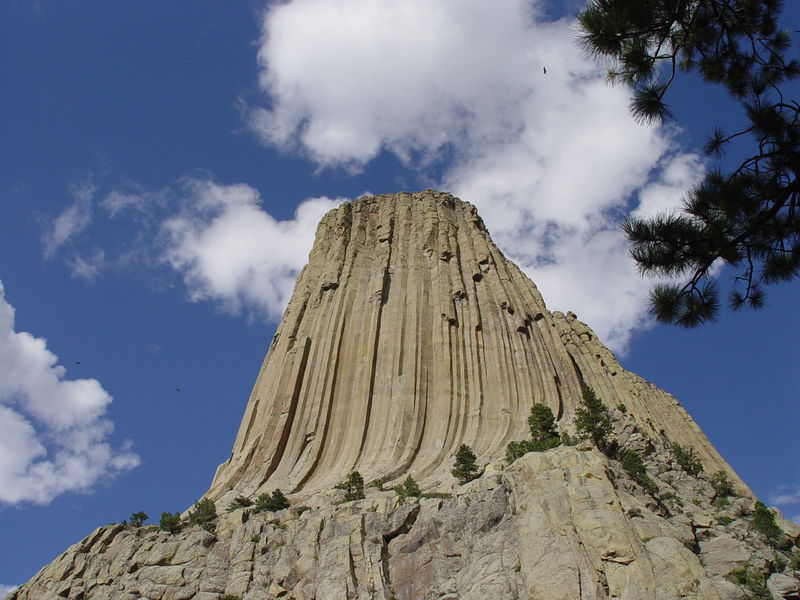
Is this an intrusive or an extrusive igneous rock?
From this view the amazing structure of rocks that make up Devil's Tower doesn't really indicate whether the structure formed slowly or quickly. A close up view would show small crystals in a mafic rock, indicating a rapid cooling from a basalt lava. Cooling was slow enough that the hexagonal "posts" could form.
Igneous Rock Classification
Igneous rocks are first classified by their composition, from felsic to ultramafic. The characteristics and example minerals in each type are included in Tablebelow.
Properties of Igneous Rock Compositions
Composition
Color
Density
Minerals
Felsic
Light
Low
Quartz, orthoclase feldspar
Intermediate
Intermediate
Intermediate
Plagioclase feldspar, biotite, amphibole
Mafic
Dark
High
Olivine, pyroxene
Ultramafic
Very dark
Very high
Olivine
Second to composition in igneous rock classification is texture. Texture indicates how the magma that formed the rock cooled.
Silica Composition and Texture of Major Igneous Rocks
Type
Amount of Silica
Extrusive
Intrusive
Ultramafic
<45%
Komatiite
Peridotite
Mafic
45-52%
Basalt
Gabbro
Intermediate
52-63%
Andesite
Diorite
Intermediate-Felsic
63-69%
Dacite
Granodiorite
Felsic
>69% SiO2
Rhyolite
Granite
Some of the rocks in Tableabove were pictured earlier in previous concepts about rocks. Look back at them and, using what you know about the size of crystals in extrusive and intrusive rocks and the composition of felsic and mafic rocks, identify the rocks in the photos in Figurebelow:
These are photos of A) rhyolite, B) gabbro, C) peridotite, and D) komatiite.
Summary
Composition is the first criteria on which to classify igneous rocks, with categories from felsic to ultramafic; color is a first order indicator of composition.
Texture is the second criteria for classifying igneous rocks because texture indicates how a rock cooled.
Igneous rocks are categorized in pairs with the same composition but different textures: gabbro-basalt, diorite-andesite, and granite-rhyolite.
Review
Describe the formation of the igneous rock pair gabbro-basalt. What makes the rocks the same and what makes them different?
How does the composition of a rock affect its color?
What are ultramafic rocks and where are they likely to be found?
Explore More
Use this resource to answer the questions that follow.
What is one way that igneous rocks are classified?
What are the two categories of igneous rocks based on composition?
How is felsic igneous rock?
What is mafic igneous rock?
What is the same about granite and rhyolite? What is different?
What is the same about gabbro and basalt? What is different?
Notes/Highlights
Color
Highlighted Text
Notes
Please Sign In to create your own Highlights / Notes


 FlexiA FREE Digital Tutor for Every Student
 FlexBooks 2.0Customizable, digital textbooks in a new, interactive platform
 FlexBooksCustomizable, digital textbooks
 SchoolsFlexBooks from schools and districts near you
 Study GuidesQuick review with key information for each concept
 Adaptive PracticeBuilding knowledge at each student’s skill level
 SimulationsInteractive Physics & Chemistry Simulations
 PLIXPlay. Learn. Interact. eXplore.
 CCSS MathConcepts and FlexBooks aligned to Common Core
 NGSSConcepts aligned to Next Generation Science Standards
 Certified EducatorStand out as an educator. Become CK-12 Certified.
 WebinarsLive and archived sessions to learn about CK-12