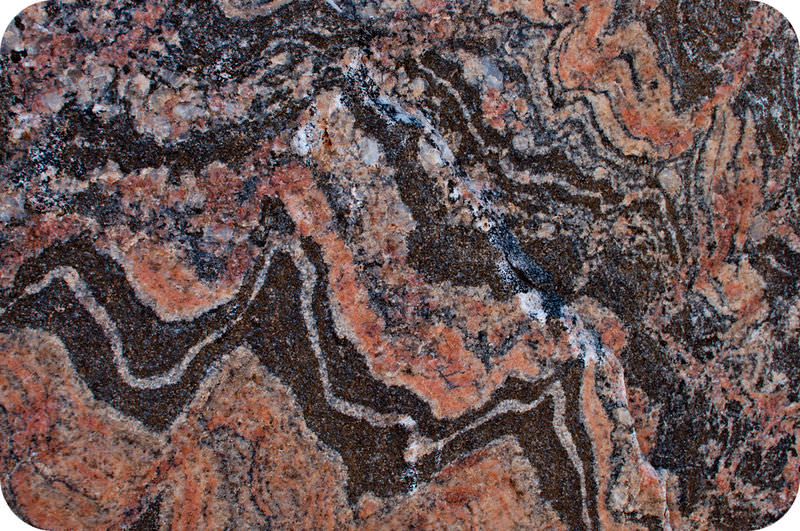
The rock in this photo is a banded gneiss. The bands are of different composition, more felsic and more mafic, that separated as a result of heat and pressure. The waviness of the bands also shows how the rock was hot enough to alter but not to melt all the way.
Metamorphism
Any type of rock – igneous, sedimentary, or metamorphic — can become a metamorphic rock. All that is needed is enough heat and/or pressure to alter the existing rock’s physical or chemical makeup without melting the rock entirely. Rocks change during metamorphism because the minerals need to be stable under the new temperature and pressure conditions. The need for stability may cause the structure of minerals to rearrange and form new minerals. Ions may move between minerals to create minerals of different chemical composition. Hornfels, with its alternating bands of dark and light crystals, is a good example of how minerals rearrange themselves during metamorphism. Hornfels is shown in the table for the "Metamorphic Rock Classification" concept.
Texture
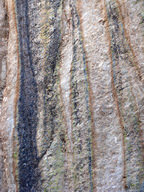
Extreme pressure may also lead to foliation, the flat layers that form in rocks as the rocks are squeezed by pressure (Figurebelow). Foliation normally forms when pressure is exerted in only one direction. Metamorphic rocks may also be non-foliated. Quartzite and marble, shown in the concept "Metamorphic Rock Classification," are non-foliated.
A foliated metamorphic rock.
Types of Metamorphism
The two main types of metamorphism are both related to heat within Earth:
Regional metamorphism: Changes in enormous quantities of rock over a wide area caused by the extreme pressure from overlying rock or from compression caused by geologic processes. Deep burial exposes the rock to high temperatures.
Contact metamorphism: Changes in a rock that is in contact with magma. The changes occur because of the magma’s extreme heat.
Summary
Any type of rock - igneous, sedimentary or metamorphic - can become a metamorphic rock.
Foliated rocks form when rocks being metamorphosed are exposed to pressure in one direction.
Regional metamorphism occurs over a large area but contact metamorphism occurs when a rock is altered by a nearby magma.
Review
Why do changes in temperature or pressure cause rocks to change?
What are the similarities and differences in conditions that cause regional versus contact metamorphism?
What causes foliation in a metamorphic rock? Under what circumstances would you expect this to happen?
Vocabulary
termdefinition
contact metamorphismchanges in a rock that result from temperature increases when a body of magma contacts a cooler existing rock.
foliationflat layers in rocks due to squeezing by pressure, indicating some type of metamorphic rocks.
regional metamorphisma type of metamorphic change in rock that occur because of high pressure over a large area.
Notes/Highlights
Color
Highlighted Text
Notes
Please Sign In to create your own Highlights / Notes

 FlexiA FREE Digital Tutor for Every Student
 FlexBooks 2.0Customizable, digital textbooks in a new, interactive platform
 FlexBooksCustomizable, digital textbooks
 SchoolsFlexBooks from schools and districts near you
 Study GuidesQuick review with key information for each concept
 Adaptive PracticeBuilding knowledge at each student’s skill level
 SimulationsInteractive Physics & Chemistry Simulations
 PLIXPlay. Learn. Interact. eXplore.
 CCSS MathConcepts and FlexBooks aligned to Common Core
 NGSSConcepts aligned to Next Generation Science Standards
 Certified EducatorStand out as an educator. Become CK-12 Certified.
 WebinarsLive and archived sessions to learn about CK-12