How could a mineral crystal grow as big as two giraffes?
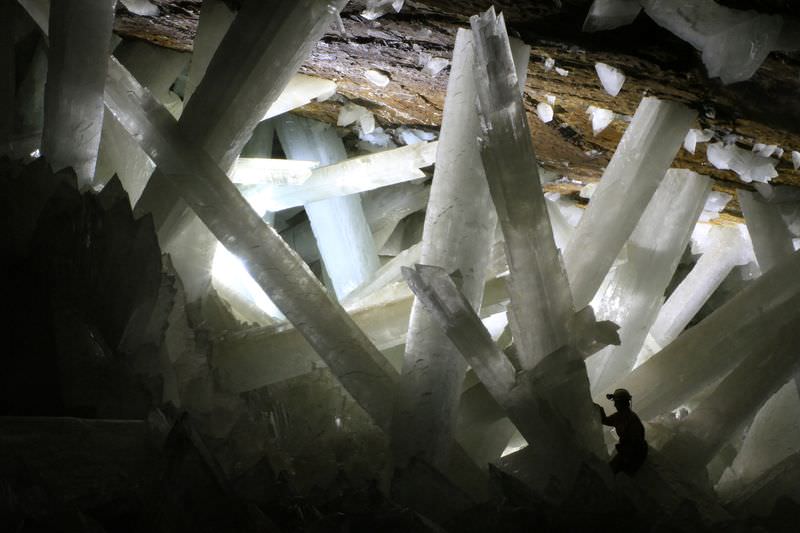
The crystals in Giant Crystal Cave in Mexico measure up to 36 feet long. How could minerals grow that big? Beyond requiring many years, the environment was completely suited for crystal growth, with lots of space, a perfect 136oF temperature and lots of mineral-rich water.
Mineral Groups
Minerals are divided into groups based on chemical composition. Most minerals fit into one of eight mineral groups.
Silicate Minerals
The roughly 1,000 silicate minerals make up over 90% of Earth's crust. Silicates are by far the largest mineral group. Feldspar and quartz are the two most common silicate minerals. Both are extremely common rock-forming minerals.
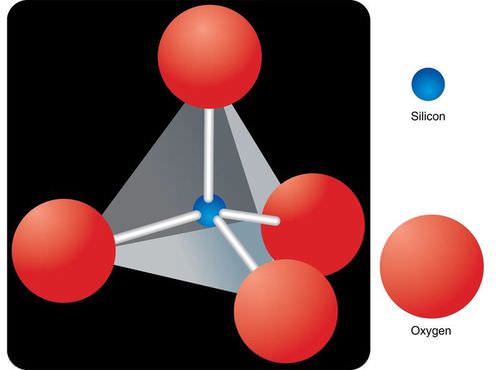
The basic building block for all silicate minerals is the silica tetrahedron, which is illustrated in Figurebelow. To create the wide variety of silicate minerals, this pyramid-shaped structure is often bound to other elements, such as calcium, iron, and magnesium.
One silicon atom bonds to four oxygen atoms to form a silica tetrahedron.
Silica tetrahedrons combine together in six different ways to create different types of silicates (Figurebelow). Tetrahedrons can stand alone, form connected circles called rings, link into single and double chains, form large flat sheets of pyramids, or join in three dimensions.
The different ways that silica tetrahedrons can join together cause these two minerals to look very different.
Native Elements
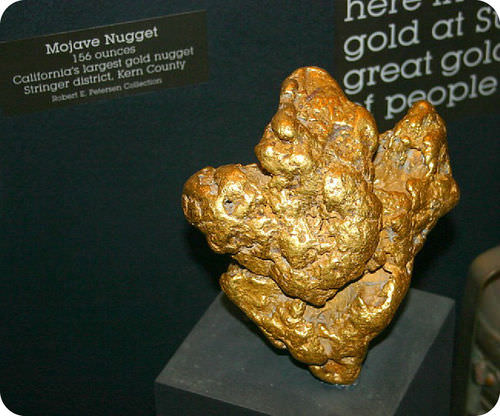
Native elements contain atoms of only one type of element. Only a small number of minerals are found in this category. Some of the minerals in this group are rare and valuable. Gold (Figurebelow), silver, sulfur, and diamond are examples of native elements.
A gold nugget.
Carbonates
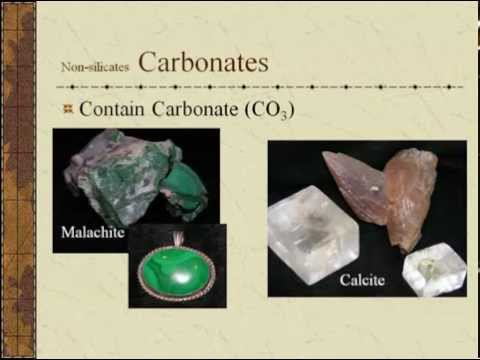
The basic carbonate structure is one carbon atom bonded to three oxygen atoms. Carbonates consists of some cation (like Ca, Fe, Cu, Mg, Ba, Sr, Pb) bonded to a carbonate molecule. Calcite (CaCO3) is the most common carbonate mineral (Figurebelow).
Calcite.
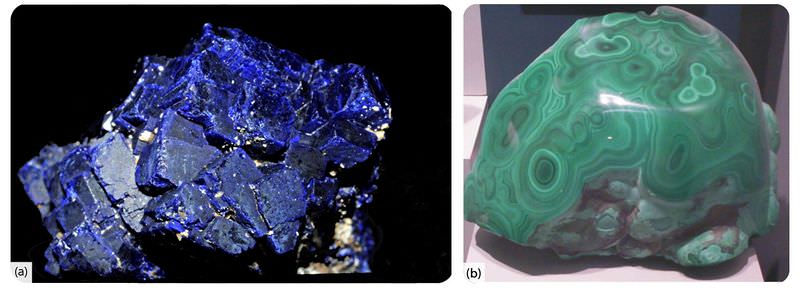
Two carbonate minerals: (a) deep blue azurite and (b) opaque green malachite. Azurite and malachite are carbonates that contain copper instead of calcium.
Halides
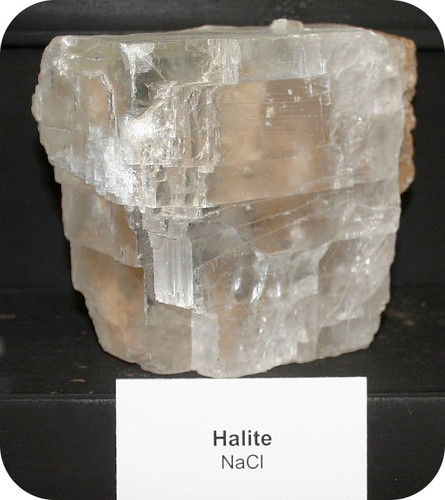
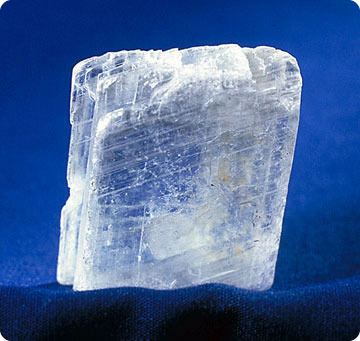
Halide minerals are salts that form when salt water evaporates. Halite is a halide mineral, but table salt (see Figurebelow) is not the only halide. The chemical elements known as the halogens (fluorine, chlorine, bromine, or iodine) bond with various metallic atoms to make halide minerals. All halides are ionic minerals, which means that they are typically soluble in water.
Beautiful halite crystal.
Oxides
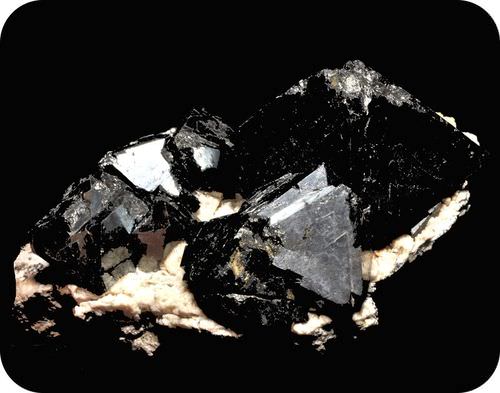
Oxides contain one or two metal elements combined with oxygen. Many important metal ores are oxides. Hematite (Fe2O3), with two iron atoms to three oxygen atoms, and magnetite (Fe3O4) (Figurebelow), with three iron atoms to four oxygen atoms, are both iron oxides.
Magnetite is one of the most distinctive oxides since it is magnetic.
Phosphates
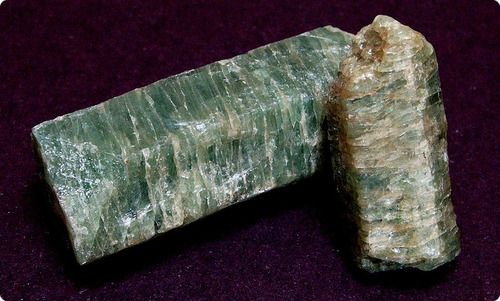
Phosphate minerals are similar in atomic structure to the silicate minerals. In the phosphates, phosphorus bonds to oxygen to form a tetrahedron. As a mineral group they aren't particularly common or important rock-forming minerals, but they are important for you and I. Apatite (Figurebelow) is a phosphate (Ca5(PO4)3(F,OH)) and is one of the major components of human bone!
Apatite.
Sulfates
Sulfate minerals contain sulfur atoms bonded to four oxygen atoms, just like silicates and phosphates. Like halides, they form where salt water evaporates. The most common sulfate mineral is probably gypsum (CaSO4 • 2H2O) (Figurebelow). Some gigantic 11-meter gypsum crystals have been found (See opening image). That is about as long as a school bus!
Gypsum.
Sulfides
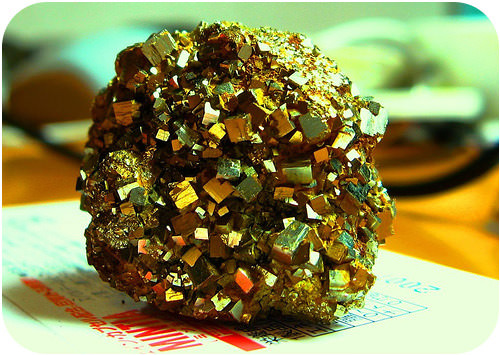
Sulfides are formed when metallic elements combine with sulfur in the absence of oxygen. Pyrite (Figurebelow) (FeS2) is a common sulfide mineral colloquially known as "fool’s gold" because it has a golden metallic looking mineral. There are three easy ways to discriminate real gold from fools gold: real gold is extremely dense, real gold does not grow into perfect cubes, as pyrite commonly does, and pyrite smells like rotten eggs (because of the sulfur).
This mineral has shiny, gold, cubic crystals with striations, so it is pyrite.
Summary
Silicates, made of building blocks of silica tetrahedrons, are the most abundant minerals on Earth.
Silica tetrahedrons combine together in six different ways to create rings, single and double chains, large flat sheets, or 3-dimensional structures.
Other mineral groups have other anions like carbonates, oxides, or phosphates.
Minerals that are native elements are made of only one element.
Review
What is the most common group of minerals on Earth? What do they all contain?
How are the silicates categorized?
Your friend brings you a fist-sized perfect cube of a golden mineral, which he tells you is gold. What should you and your friend consider before determining that he is right?
Explore More
Use this resource to answer the questions that follow.
What mineral group is 96% of Earth's crust made of? What are the two most common examples of this mineral group?
What are the halides and what are the common ions that create them, the anions (negatively charged) and cations (positively charged)?
What do all carbonates contain? If the cation is copper, what is the mineral?
What do all sulfates contain? Which sulfate is sheet rock made of?
What do all sulfides contain? What other element does pyrite contain?
What do all oxides contain? If an aluminum oxide is blue what is it?
What is the characteristic of native elements? Name Au, Cu, S, C
Vocabulary
termdefinition
silicateminerals of silicon atoms bonded to oxygen atoms.
Notes/Highlights
Color
Highlighted Text
Notes
Please Sign In to create your own Highlights / Notes
 AI Teacher Tools

 FlexiA FREE Digital Tutor for Every Student
 FlexBooks 2.0Customizable, digital textbooks in a new, interactive platform
 FlexBooksCustomizable, digital textbooks
 SchoolsFlexBooks from schools and districts near you
 Study GuidesQuick review with key information for each concept
 Adaptive PracticeBuilding knowledge at each student’s skill level
 SimulationsInteractive Physics & Chemistry Simulations
 PLIXPlay. Learn. Interact. eXplore.
 CCSS MathConcepts and FlexBooks aligned to Common Core
 NGSSConcepts aligned to Next Generation Science Standards
 Certified EducatorStand out as an educator. Become CK-12 Certified.
 WebinarsLive and archived sessions to learn about CK-12