Check out the mineral above. How would you figure out what kind of mineral it is? By color? Shape? Whether it's shiny or dull? Are there lines (striations) running across the minerals? This mineral has shiny, gold, cubic crystals with striations, and smells like sulfur. What is it? In this concept, we will discuss how to identify a mineral as one would "in the field," that is, without using fancy lab equipment.
How Are Minerals Identified?
There are a multitude of laboratory and field techniques for identifying minerals. While a mineralogist might use a high-powered microscope to identify some minerals, or even techniques like x-ray diffraction, most are recognizable using physical properties.
The most common field techniques put the observer in the shoes of a detective, whose goal it is to determine, by process of elimination, what the mineral in question is. The process of elimination usually includes observing things like color, hardness, smell, solubility in acid, streak, striations and/or cleavage.
Check out the mineral in the opening image. What is the mineral’s color? What is its shape? Are the individual crystals shiny or dull? Are there lines (striations) running across the minerals? In this concept, the properties used to identify minerals are described in more detail.
Color, Streak, and Luster
Color
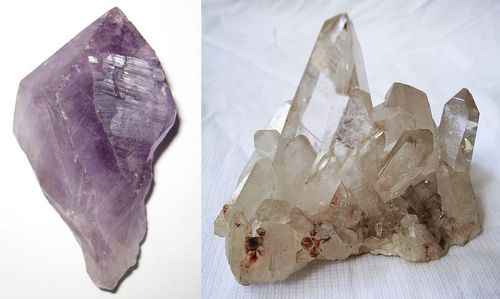
Color may be the first feature you notice about a mineral, but color is not often important for mineral identification. For example, quartz can be colorless, purple (amethyst), or a variety of other colors depending on chemical impurities Figurebelow.
Purple quartz, known as amethyst, and clear quartz are the same mineral despite the different colors.
Streak
Streak is the color of a mineral's powder, which often is not the same color as the mineral itself. Many minerals, such as the quartz in the Figureabove, do not have streak.
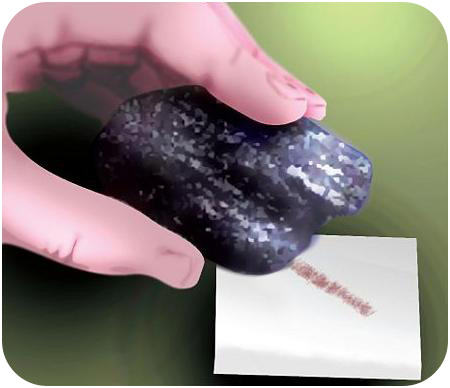
Hematite is an example of a mineral that displays a certain color in hand sample (typically black to steel gray, sometimes reddish), and a different streak color (red/brown).
The streak of hematite across an unglazed porcelain plate is red-brown.
Luster
Luster describes the reflection of light off a mineral’s surface. Mineralogists have special terms to describe luster. One simple way to classify luster is based on whether the mineral is metallic or non-metallic. Minerals that are opaque and shiny, such as pyrite, have a metallic luster. Minerals such as quartz have a non-metallic luster. Different types of non-metallic luster are described in Tablebelow.
Six types of non-metallic luster
Luster
Appearance
Adamantine
Sparkly
Earthy
Dull, clay-like
Pearly
Pearl-like
Resinous
Like resins, such as tree sap
Silky
Soft-looking with long fibers
Vitreous
Glassy
Specific Gravity
Density describes how much matter is in a certain amount of space: density = mass/volume.
Mass is a measure of the amount of matter in an object. The amount of space an object takes up is described by its volume. The density of an object depends on its mass and its volume. For example, the water in a drinking glass has the same density as the water in the same volume of a swimming pool.
Gold has a density of about 19 g/cm3; pyrite has a density of about 5 g/cm3 - that’s another way to tell pyrite from gold. Quartz is even less dense than pyrite and has a density of 2.7 g/cm3.
The specific gravity of a substance compares its density to that of water. Substances that are more dense have higher specific gravity.
Hardness
Hardness is a measure of whether a mineral will scratch or be scratched. Mohs Hardness Scale, shown in Tablebelow, is a reference for mineral hardness.
Mohs Hardness Scale: 1 (softest) to 10 (hardest).
Hardness
Mineral
1
Talc
2
Gypsum
3
Calcite
4
Fluorite
5
Apatite
6
Feldspar
7
Quartz
8
Topaz
9
Corundum
10
Diamond
With a Mohs scale, anyone can test an unknown mineral for its hardness. Imagine you have an unknown mineral. You find that it can scratch fluorite or even apatite, but feldspar scratches it. You know then that the mineral’s hardness is between 5 and 6. Note that no other mineral can scratch diamond.
Cleavage and Fracture
Breaking a mineral breaks its chemical bonds. Since some bonds are weaker than other bonds, each type of mineral is likely to break where the bonds between the atoms are weaker. For that reason, minerals break apart in characteristic ways.
Cleavage is the tendency of a mineral to break along certain planes to make smooth surfaces. Halite (Figurebelow) breaks between layers of sodium and chlorine to form cubes with smooth surfaces.
Halite has cubic cleavage.
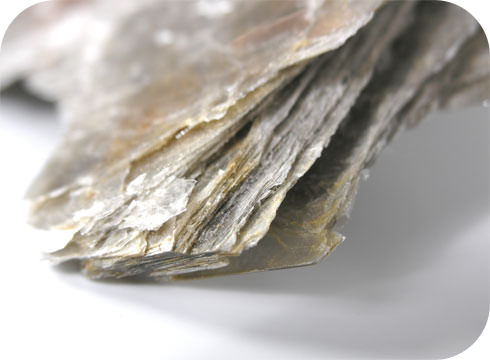
Mica has cleavage in one direction and forms sheets (Figurebelow).
Sheets of mica.
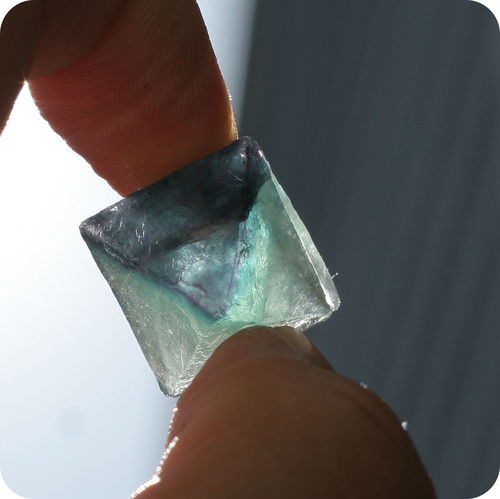
Minerals can cleave into polygons. Magnetite forms octahedrons (Figurebelow).
Fluorite has octahedral cleavage.
One reason gemstones are beautiful is that the cleavage planes make an attractive crystal shape with smooth faces.
Fracture is a break in a mineral that is not along a cleavage plane. Fracture is not always the same in the same mineral because fracture is not determined by the structure of the mineral.
Minerals may have characteristic fractures (Figurebelow). Metals usually fracture into jagged edges. If a mineral splinters like wood, it may be fibrous. Some minerals, such as quartz, form smooth curved surfaces when they fracture.
Chrysotile has splintery fracture.
Other Identifying Characteristics
Some minerals have other unique properties, some of which are listed in Tablebelow. Can you name a unique property that would allow you to instantly identify a mineral that’s been described quite a bit in this concept? (Hint: It is most likely found on your dinner table.)
Some minerals have unusual properties that can be used for identification.
Property
Description
Example of Mineral
Fluorescence
Mineral glows under ultraviolet light
Fluorite
Magnetism
Mineral is attracted to a magnet
Magnetite
Radioactivity
Mineral gives off radiation that can be measured with Geiger counter
Uraninite
Reactivity
Bubbles form when mineral is exposed to a weak acid
Calcite
Smell
Some minerals have a distinctive smell
Sulfur (smells like rotten eggs)
Taste
Some minerals taste salty
Halite
Summary
Some minerals have a unique property that makes them fairly easy to identify, such as high specific gravity or salty taste.
Color is not a reliable indicator of mineral type for most minerals, but streak is for certain minerals.
Cleavage can be a unique and beautiful indicator of mineral type.
Review
How does the color of a mineral differ from it's streak and luster?
Does diamond exhibit cleavage or fracture? Why is this important?
What's the first thing you should do when trying to identify a mineral? What do you do if you still can't identify it?
Explore More
Use this resource to answer the questions that follow.
What are two reasons that color isn't a good way to identify minerals?
What is luster? List are some types of luster with one to a few words to describe each.
What is streak? Why is streak color a better indicator of a mineral's color?
What is hardness? What are the least and most hard minerals on the Moh's scale?
How do you use reference minerals to tell the hardness of an unknown mineral?
What is the difference between cleavage and fracture?
Would a mineral that exhibits fracture but not cleavage be a good gemstone? Why or why not?
Resources
NOTES / HIGHLIGHTS
Please Sign In to create your own Highlights / Notes
Vocabulary
termdefinition
cleavagethe tendency of a mineral to break along certain planes to make smooth surfaces.
densitythe ratio of the mass of an object to its volume; a measure of the amount of matter in a certain amount of space.
hardnessthe ability of a mineral to resist scratching.
lusterthe way light reflects off of the surface of the mineral.
Notes/Highlights
Color
Highlighted Text
Notes
Please Sign In to create your own Highlights / Notes
 AI Teacher Tools

 FlexiA FREE Digital Tutor for Every Student
 FlexBooks 2.0Customizable, digital textbooks in a new, interactive platform
 FlexBooksCustomizable, digital textbooks
 SchoolsFlexBooks from schools and districts near you
 Study GuidesQuick review with key information for each concept
 Adaptive PracticeBuilding knowledge at each student’s skill level
 SimulationsInteractive Physics & Chemistry Simulations
 PLIXPlay. Learn. Interact. eXplore.
 CCSS MathConcepts and FlexBooks aligned to Common Core
 NGSSConcepts aligned to Next Generation Science Standards
 Certified EducatorStand out as an educator. Become CK-12 Certified.
 WebinarsLive and archived sessions to learn about CK-12