Yes! (At least if you think that diamond is a girl's best friend, anyway.) When people think of carbon they think of black dust left over from a fire, but the diamond is just carbon that was squeezed very hard at extremely high pressure. Formed at lower pressure, the carbon mineral is graphite, the mineral that is pencil "lead." Graphite would make a very different sort of ring.
a change to a more stable state as in metamorphism
precipitation from vapor
Formation from Magma
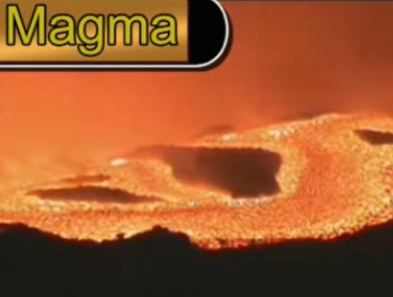
Imagine a rock that becomes so hot it melts. Many minerals start out in liquids that are hot enough to melt rocks. Magma is melted rock inside Earth, a molten mixture of substances that can be hotter than 1,000°C. Magma cools slowly inside Earth, which gives mineral crystals time to grow large enough to be seen clearly (Figurebelow).
Granite is rock that forms from slowly cooled magma, containing the minerals quartz (clear), plagioclase feldspar (shiny white), potassium feldspar (pink), and biotite (black).
When magma erupts onto Earth's surface, it is called lava. Lava cools much more rapidly than magma. Crystals do not have time to form and are very small. The chemical composition between minerals that form rapidly or slowly is often the same, only their size differs.
Existing rocks may be heated enough so that the molecules are released from their structure and can move around. The molecules may match up with different molecules to form new minerals as the rock cools. This occurs during metamorphism, which will be discussed in the "Metamorphic Rocks" concept.
Formation from Solutions
Water on Earth, such as the water in the oceans, contains chemical elements mixed into a solution. Various processes can cause these elements to combine to form solid mineral deposits.
Minerals from Salt Water
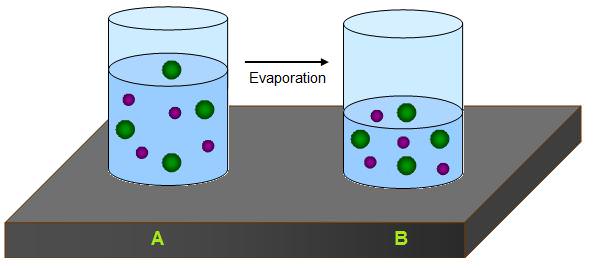
When water evaporates, it leaves behind a solid precipitate of minerals, as shown in Figurebelow.
When the water in glass A evaporates, the dissolved mineral particles are left behind.
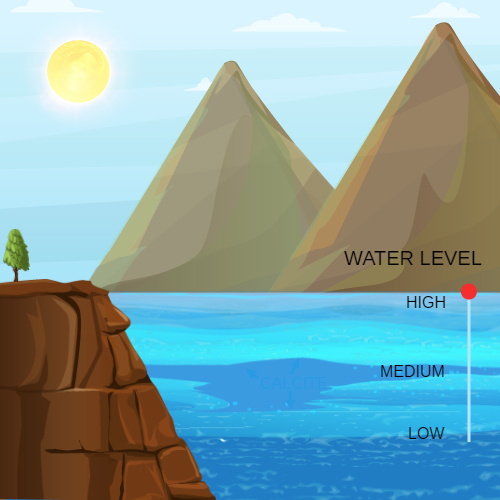
Water can only hold a certain amount of dissolved minerals and salts. When the amount is too great to stay dissolved in the water, the particles come together to form mineral solids, which sink. Halite easily precipitates out of water, as does calcite. Some lakes, such as Mono Lake in California (Figurebelow) or The Great Salt Lake in Utah, contain many mineral precipitates.
Tufa towers form when calcium-rich spring water at the bottom of Mono Lake bubbles up into the alkaline lake. The tufa towers appear when lake level drops.
Minerals from Hot Underground Water
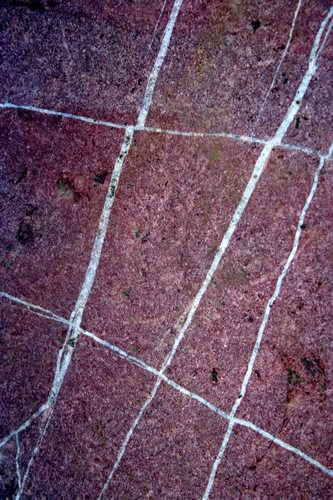
Magma heats nearby underground water, which reacts with the rocks around it to pick up dissolved particles. As the water flows through open spaces in the rock and cools, it deposits solid minerals. The mineral deposits that form when a mineral fills cracks in rocks are called veins (Figurebelow).
Quartz veins formed in this rock.
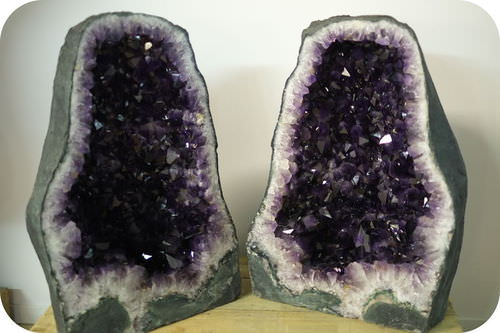
When minerals are deposited in open spaces, large crystals form (Figurebelow).
Amethyst formed when large crystals grew in open spaces inside the rock. These special rocks are called geodes.
Minerals Under Pressure
In the last several years, many incredible discoveries have been made exploring how minerals behave under high pressure, like rocks experience inside the Earth. If a mineral is placed in a special machine and then squeezed, eventually it may convert into a different mineral. Ice is a classic example of a material that undergoes solid-solid "phase transitions" as pressure and/or temperature is changed. A "phase diagram" is a graph which plots the stability of phases of a compound as a function of pressure and temperature.
A phase diagram for water (ice) is included in the Figurebelow. The phase diagram is split up into 3 main areas for the solid crystalline phase (ice), the liquid phase (water), and the gas phase (water vapor). Notice that increasing pressure lowers the freezing point and raises the boiling point of water. What does that do to the stability conditions of the liquid phase?
A sample phase diagram for water.
Summary
Minerals form as magma cools.
Minerals form when they precipitate from hot fluids that have cooled down.
Minerals form when the concentration of ions gets too great in a fluid.
Review
How do minerals form in veins?
How do minerals form from cool water?
When do large crystals form from magma? When do small crystals form from magma?
Vocabulary
termdefinition
lavamolten rock that has reached the Earth's surface.
magmamolten rock deep inside the Earth.
veinminerals that cooled from a fluid and filled cracks in a rock.
Notes/Highlights
Color
Highlighted Text
Notes
Please Sign In to create your own Highlights / Notes


 FlexiA FREE Digital Tutor for Every Student
 FlexBooks 2.0Customizable, digital textbooks in a new, interactive platform
 FlexBooksCustomizable, digital textbooks
 SchoolsFlexBooks from schools and districts near you
 Study GuidesQuick review with key information for each concept
 Adaptive PracticeBuilding knowledge at each student’s skill level
 SimulationsInteractive Physics & Chemistry Simulations
 PLIXPlay. Learn. Interact. eXplore.
 CCSS MathConcepts and FlexBooks aligned to Common Core
 NGSSConcepts aligned to Next Generation Science Standards
 Certified EducatorStand out as an educator. Become CK-12 Certified.
 WebinarsLive and archived sessions to learn about CK-12