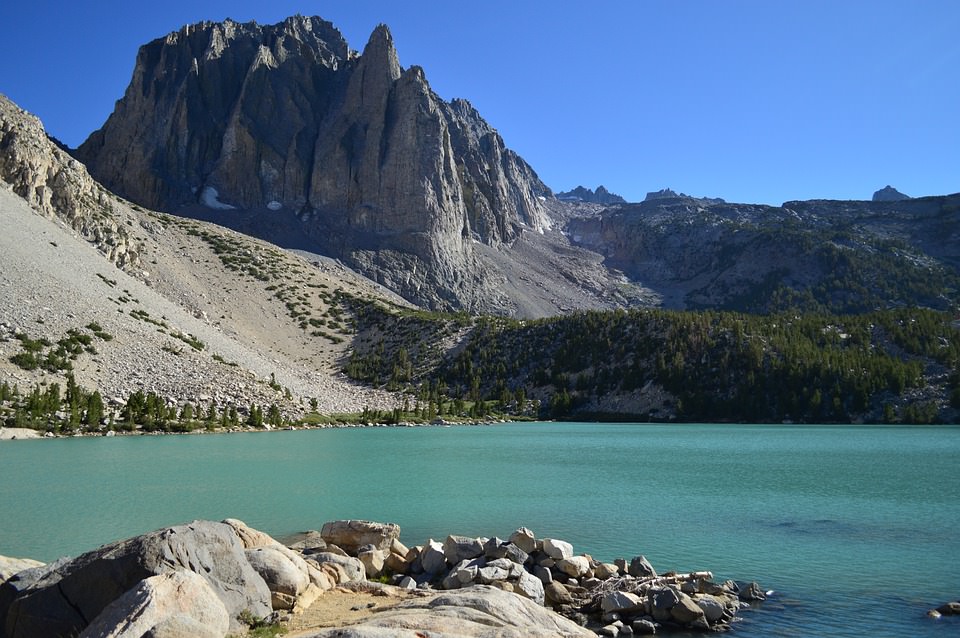
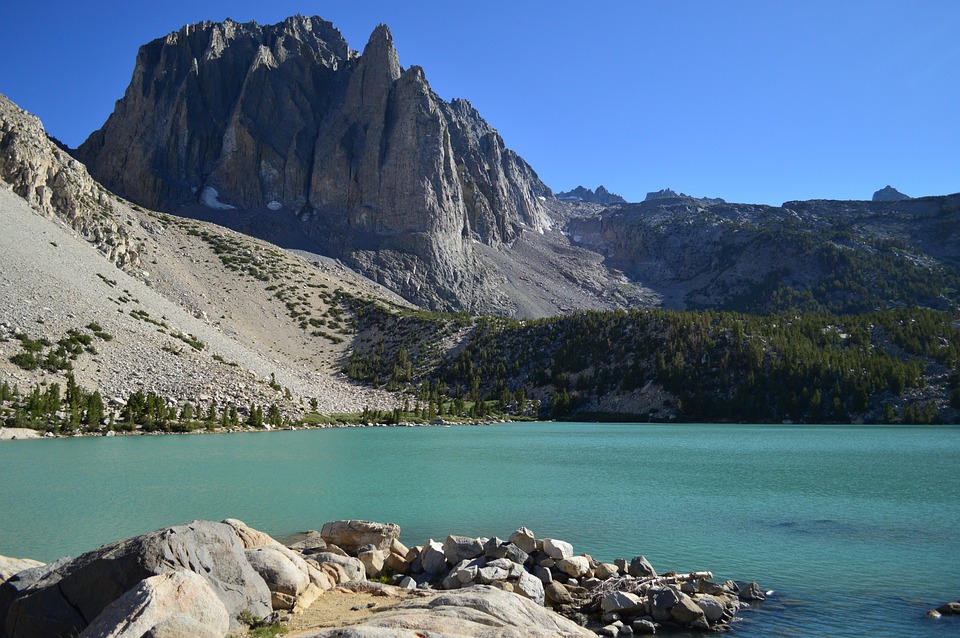
This photo is of the Sierra Nevada Mountains in California. The rocks look so uniform because they are all igneous intrusive rocks that cooled from a felsic magma to create the granite that you see. Later, the rock was uplifted and modified by glaciers during the Pleistocene ice ages.
Magma Composition
Different factors play into the composition of a magma and the rock it produces.
Composition of the Original Rock
The rock beneath the Earth’s surface is sometimes heated to high enough temperatures that it melts to create magma. Different magmas have different composition and contain whatever elements were in the rock or rocks that melted. Magmas also contain gases. The main elements are the same as the elements found in the crust. Tablebelow lists the abundance of elements found in the Earth's crust and in magma. The remaining 1.5% is made up of many other elements that are present in tiny quantities.
Elements in Earth's Crust and Magma
Element
Symbol
Percent
Oxygen
O
46.6%
Silicon
Si
27.7%
Aluminum
Al
8.1%
Iron
Fe
5.0%
Calcium
Ca
3.6%
Sodium
Na
2.8%
Potassium
K
2.6%
Magnesium
Mg
2.1%
Total
98.5%
How Rocks Melt
Whether rock melts to create magma depends on:
Temperature: Temperature increases with depth, so melting is more likely to occur at greater depths.
Pressure: Pressure increases with depth, but increased pressure raises the melting temperature, so melting is less likely to occur at higher pressures.
Water: The addition of water changes the melting point of rock. As the amount of water increases, the melting point decreases.
Rock composition: Minerals melt at different temperatures, so the temperature must be high enough to melt at least some minerals in the rock. The first mineral to melt from a rock will be quartz (if present) and the last will be olivine (if present).
The different geologic settings that produce varying conditions under which rocks melt will be discussed in the chapter Plate Tectonics.
What Melts and What Crystallizes
As a rock heats up, the minerals that melt at the lowest temperatures melt first. Partial melting occurs when the temperature on a rock is high enough to melt only some of the minerals in the rock. The minerals that will melt will be those that melt at lower temperatures. Fractional crystallization is the opposite of partial melting. This process describes the crystallization of different minerals as magma cools.
Bowen’s Reaction Series indicates the temperatures at which minerals melt or crystallize (Figurebelow). An understanding of the way atoms join together to form minerals leads to an understanding of how different igneous rocks form. Bowen’s Reaction Series also explains why some minerals are always found together and some are never found together.
Bowen’s Reaction Series.
If the liquid separates from the solids at any time in partial melting or fractional crystallization, the chemical composition of the liquid and solid will be different. When that liquid crystallizes, the resulting igneous rock will have a different composition from the parent rock.
Summary
Melting of an existing rock to create magma depends on that rock's composition and on the temperature, pressure, and water content found in that environment.
Bowen's Reaction Series indicates the temperatures at which minerals crystallize from a magma or melt from a rock.
Since minerals melt at different temperatures, a rock in which some minerals have melted has undergone partial melting; the opposite process, in which some minerals crystallize out of a magma, is fractional crystallization.
Review
Why are olivine and quartz never found together in an igneous rock?
How do changes in temperature, pressure, and fluids cause melting?
Briefly describe what Bowen's Reaction Series depicts.
Explore More
Use this resource to answer the questions that follow.
What do all igneous rocks form from?
How does crystallization occur?
Explain how extrusive igneous rock is formed. What is the sign that a rock is an extrusive rock?
Explain how intrusive igneous rock is formed. What is the sign that a rock is an intrusive rock?
Vocabulary
termdefinition
fractional crystallizationthe crystallization of a fraction of the minerals in magma depending on temperature.
partial meltingthe melting of some, but not all, of the minerals in a rock, depending on temperature.
Notes/Highlights
Color
Highlighted Text
Notes
Please Sign In to create your own Highlights / Notes


 FlexiA FREE Digital Tutor for Every Student
 FlexBooks 2.0Customizable, digital textbooks in a new, interactive platform
 FlexBooksCustomizable, digital textbooks
 SchoolsFlexBooks from schools and districts near you
 Study GuidesQuick review with key information for each concept
 Adaptive PracticeBuilding knowledge at each student’s skill level
 SimulationsInteractive Physics & Chemistry Simulations
 PLIXPlay. Learn. Interact. eXplore.
 CCSS MathConcepts and FlexBooks aligned to Common Core
 NGSSConcepts aligned to Next Generation Science Standards
 Certified EducatorStand out as an educator. Become CK-12 Certified.
 WebinarsLive and archived sessions to learn about CK-12