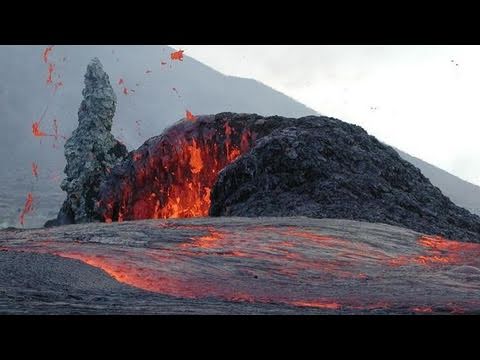
This rock is lava that rapidly cooled on Kilauea volcano in Hawaii Volcanoes National Park on the Big Island of Hawaii. The lava cooled so fast that crystals had little time to form. How does this rock compare with the granite further down this lesson?
Intrusive and Extrusive Igneous Rocks
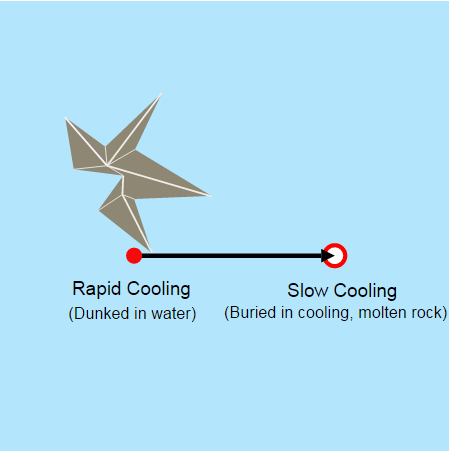
The rate at which magma cools determines whether an igneous rock is intrusive or extrusive. The cooling rate is reflected in the rock's texture.
Intrusive Igneous Rocks
Igneous rocks are called intrusive when they cool and solidify beneath the surface. Intrusive rocks form plutons and so are also called plutonic. A pluton is an igneous intrusive rock body that has cooled in the crust. When magma cools within the Earth, the cooling proceeds slowly. Slow cooling allows time for large crystals to form, so intrusive igneous rocks have visible crystals. Granite is the most common intrusive igneous rock (see Figurebelow for an example).
Granite is made of four minerals, all visible to the naked eye: feldspar (white), quartz (translucent), hornblende (black), and biotite (black, platy).
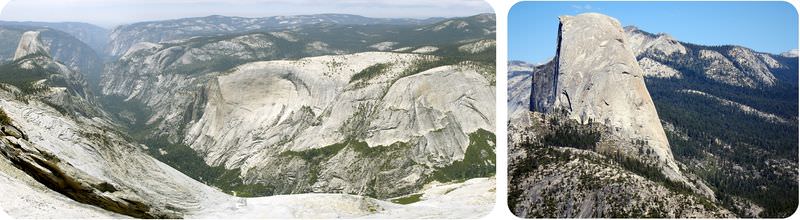
Igneous rocks make up most of the rocks on Earth. Most igneous rocks are buried below the surface and covered with sedimentary rock, or are buried beneath the ocean water. In some places, geological processes have brought igneous rocks to the surface. Figurebelow shows a landscape in California’s Sierra Nevada Mountains made of granite that has been raised to create mountains.
California’s Sierra Nevada Mountains are intrusive igneous rock exposed at Earth’s surface.
Extrusive Igneous Rocks
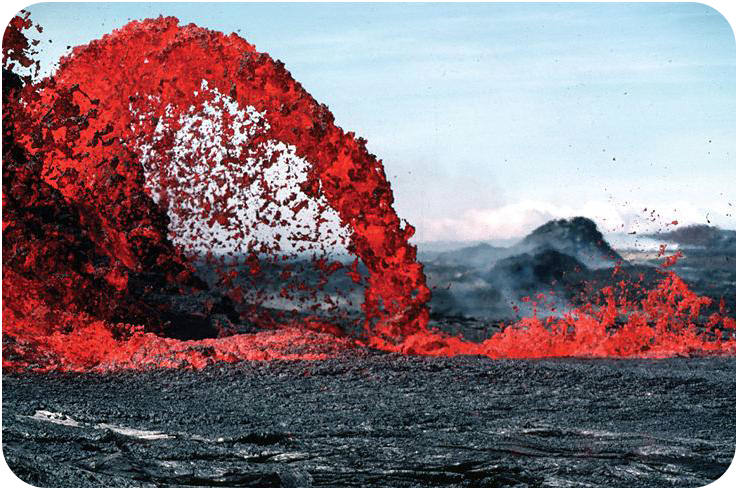
Igneous rocks are called extrusive when they cool and solidify above the surface. These rocks usually form from a volcano, so they are also called volcanic rocks (Figurebelow).
Extrusive igneous rocks form after lava cools above the surface.
Extrusive igneous rocks cool much more rapidly than intrusive rocks. There is little time for crystals to form, so extrusive igneous rocks have tiny crystals (Figurebelow).
Cooled lava forms basalt with no visible crystals. Why are there no visible crystals?
Some volcanic rocks have a different texture. The rock has large crystals set within a matrix of tiny crystals. In this case, the magma cooled enough to form some crystals before erupting. Once erupted, the rest of the lava cooled rapidly. This is called porphyritic texture.
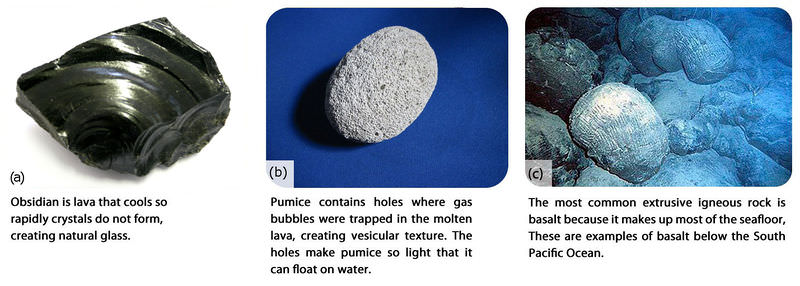
Cooling rate and gas content create other textures (see Figurebelow for examples of different textures). Lavas that cool extremely rapidly may have a glassy texture. Those with many holes from gas bubbles have a vesicular texture.
Different cooling rate and gas content resulted in these different textures.
Summary
Intrusive igneous rocks cool from magma slowly because they are buried beneath the surface, so they have large crystals.
Extrusive igneous rocks cool from lava rapidly because they form at the surface, so they have small crystals.
Texture reflects how an igneous rock formed.
Review
How does a rock develop a vesicular texture?
What are the other names for igneous intrusive rock and igneous extrusive rocks and how do they get those names?
What sequence of events causes a rock to develop porphyritic texture?
Explore More
Use this resource to answer the questions that follow.
What are the two places igneous rocks can form?
What are the features of intrusive igneous rocks and how do these rocks form?
What are the features of extrusive igneous rocks and how do these rocks form?
What is the difference between granite and gabbro? What is the difference between rhyolite and basalt?
How does obsidian form? What is its other name?
NOTES / HIGHLIGHTS
Please Sign In to create your own Highlights / Notes
Vocabulary
termdefinition
extrusiveigneous rocks that form at Earth's surface from rapidly cooling lava.
intrusiveigneous rocks that form inside the Earth from slowly cooling magma.
plutonan igneous intrusive rock body that has cooled in the crust.
porphyriticigneous rock texture in which visible crystals are found in a matrix of tiny crystals.
vesicularigneous rock texture with holes that indicate the presence of gas bubbles in the magma.
volcanic rockrock that originates in a volcano or volcanic feature, formed from lava or magma.
Notes/Highlights
Color
Highlighted Text
Notes
Please Sign In to create your own Highlights / Notes


 FlexiA FREE Digital Tutor for Every Student
 FlexBooks 2.0Customizable, digital textbooks in a new, interactive platform
 FlexBooksCustomizable, digital textbooks
 SchoolsFlexBooks from schools and districts near you
 Study GuidesQuick review with key information for each concept
 Adaptive PracticeBuilding knowledge at each student’s skill level
 SimulationsInteractive Physics & Chemistry Simulations
 PLIXPlay. Learn. Interact. eXplore.
 CCSS MathConcepts and FlexBooks aligned to Common Core
 NGSSConcepts aligned to Next Generation Science Standards
 Certified EducatorStand out as an educator. Become CK-12 Certified.
 WebinarsLive and archived sessions to learn about CK-12