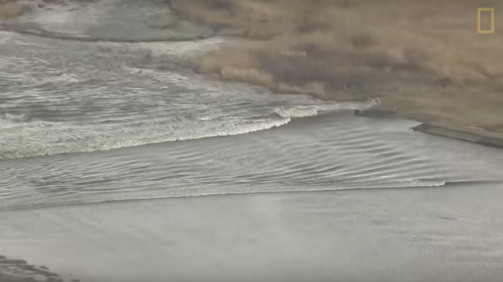
"Tsunami" is a Japanese word meaning "harbor wave." Some people call them tidal waves. But these deadly waves are not related to tides and they are not restricted to harbors. Few words can express the horror these waves can bring.
Tsunami as Waves
Tsunami are deadly ocean waves from the sharp jolt of an undersea earthquake. Less frequently, these waves can be generated by other shocks to the sea, like a meteorite impact. Fortunately, few undersea earthquakes, and even fewer meteorite impacts, generate tsunami.
Wave Height
Tsunami waves have small wave heights relative to their long wavelengths, so they are usually unnoticed at sea. When traveling up a slope onto a shoreline, the wave is pushed upward. As with wind waves, the speed of the bottom of the wave is slowed by friction. This causes the wavelength to decrease and the wave to become unstable. These factors can create an enormous and deadly wave.
Landslides, meteorite impacts, or any other jolt to ocean water may form a tsunami. Tsunami can travel at speeds of 800 kilometers per hour (500 miles per hour).
Wavelength
Since tsunami are long-wavelength waves, a long time can pass between crests or troughs. Any part of the wave can make landfall first.
In 1755 in Lisbon, Portugal, a tsunami trough hit land first. A large offshore earthquake did a great deal of damage on land. People rushed out to the open space of the shore. Once there, they discovered that the water was flowing seaward fast and some of them went out to observe. What do you think happened next? The people on the open beach drowned when the crest of the wave came up the beach.
Large tsunami in the Indian Ocean and more recently Japan have killed hundreds of thousands of people in recent years. The west coast is vulnerable to tsunami since it sits on the Pacific Ring of Fire. Scientists are trying to learn everything they can about predicting tsunamis before a massive one strikes a little closer to home.
Although most places around the Indian Ocean did not have warning systems in 2005, there is a tsunami warning system in that region now. Tsunami warning systems have been placed in most locations where tsunami are possible.
Tsunami have relatively low wave heights, so they are not noticeable until they move up a shore.
Tsunami have long wavelengths. The time between two crests or two troughs can be many minutes.
Tsunami warning systems have been placed in most locations where tsunami are possible.
Review
Why is a wave that is so powerful and tall on land unnoticeable at sea?
What should you do if you are at the beach and the water suddenly is sucked offshore?
Describe tsunami as waves in the way they travel up a shoreline and may strike as crests or troughs.
Explore More
Use this resource to answer the questions that follow.
What does the word tsunami mean in Japanese?
Why has Japan had so many tsunamis?
What causes a tsunami?
How fast do the waves travel?
What happens to the tsunami as it reaches the continental shelf?
How do tsunamis differ from regular waves?
What was the deadliest tsunami ever recorded? How many people died?
What does the Pacific Tsunami Warning Center do?
Resources
Vocabulary
termdefinition
tsunamian enormous wave generated by vertical movement of the ocean floor during an underwater earthquake; tsunamis can also be caused by volcanic eruptions, landslides, or meteorite impacts; a deadly set of waves can rise high on a beach and travel far inland.
Notes/Highlights
Color
Highlighted Text
Notes
Please Sign In to create your own Highlights / Notes
 AI Teacher Tools

 FlexiA FREE Digital Tutor for Every Student
 FlexBooks 2.0Customizable, digital textbooks in a new, interactive platform
 FlexBooksCustomizable, digital textbooks
 SchoolsFlexBooks from schools and districts near you
 Study GuidesQuick review with key information for each concept
 Adaptive PracticeBuilding knowledge at each student’s skill level
 SimulationsInteractive Physics & Chemistry Simulations
 PLIXPlay. Learn. Interact. eXplore.
 CCSS MathConcepts and FlexBooks aligned to Common Core
 NGSSConcepts aligned to Next Generation Science Standards
 Certified EducatorStand out as an educator. Become CK-12 Certified.
 WebinarsLive and archived sessions to learn about CK-12