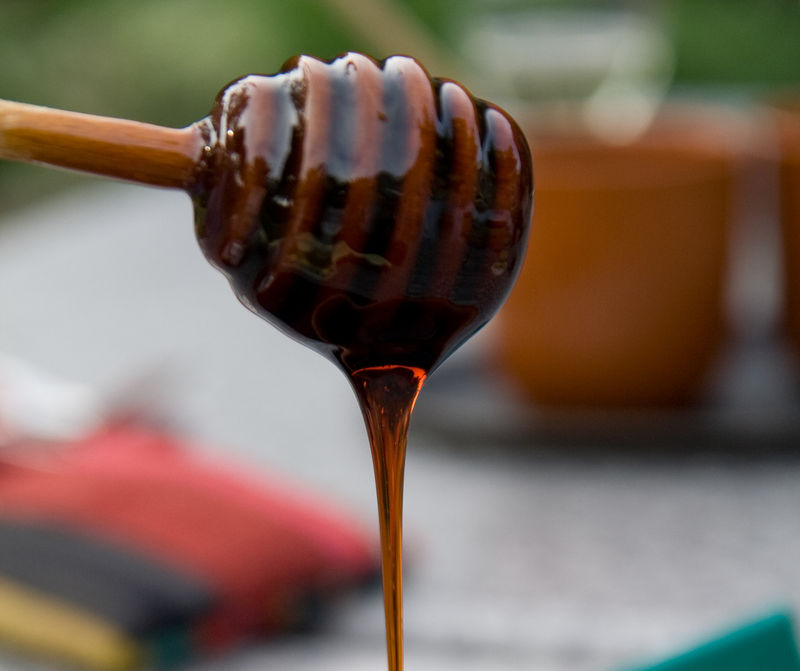
Honey, of course! The composition of magma determines its viscosity, which affects how a lava flows and what kind of volcano forms from the lava.
Magma Composition
There are as many types of volcanic eruptions as there are eruptions. Actually more since an eruption can change character as it progresses. Each volcanic eruption is unique, differing in size, style, and composition of erupted material.
One key to what makes the eruption unique is the chemical composition of the magma that feeds a volcano, which determines (1) the eruption style, (2) the type of volcanic cone that forms, and (3) the composition of rocks that are found at the volcano.
Different minerals within a rock melt at different temperatures. The amount of partial melting and the composition of the original rock determine the composition of the magma.
The words that describe composition of igneous rocks also describe magma composition.
Mafic magmas are low in silica and contain more dark, magnesium- and iron-rich mafic minerals, such as olivine and pyroxene.
Felsic magmas are higher in silica and contain lighter colored minerals such as quartz and orthoclase feldspar. The higher the amount of silica in the magma, the higher is its viscosity. Viscosity is a liquid’s resistance to flow.
Viscosity determines what the magma will do. Mafic magma is not viscous and will flow easily to the surface. Felsic magma is viscous and does not flow easily. Most felsic magma will stay deeper in the crust and will cool to form igneous intrusive rocks such as granite and granodiorite. If felsic magma rises into a magma chamber, it may be too viscous to move, so it gets stuck. Dissolved gases become trapped by thick magma. The magma churns in the chamber and the pressure builds.
Magma collects in magma chambers in the crust at 160 kilometers (100 miles) beneath the surface.
Summary
Magmas differ in composition, which affects viscosity. Magma composition has a large effect on how a volcano erupts.
Felsic lavas are more viscous and erupt explosively or do not erupt.
Mafic lavas are less viscous and erupt effusively.
Review
Why do felsic lavas erupt explosively?
Why do mafic lavas erupt effusively?
How is magma composition related to viscosity?
Explore More
Use this resource (watch up to 6:00) to answer the questions that follow.
What are the two categories of magma?
What is mafic lava rich in?
Where is mafic lava eruptions more common?
What is felsic lava rich in?
Where is felsic lava found?
What are the characteristics of felsic lava?
List the characteristics of mafic lava.
What is most felsic material? What does that mean?
What is most mafic material?
NOTES / HIGHLIGHTS
Please Sign In to create your own Highlights / Notes
Vocabulary
termdefinition
eruptionthe release of magma and gases onto the Earth’s surface.
magma chambera region below a volcano where magma and gases collect.
viscositythe thickness of a liquid; its resistance to flow.
Notes/Highlights
Color
Highlighted Text
Notes
Please Sign In to create your own Highlights / Notes


 FlexiA FREE Digital Tutor for Every Student
 FlexBooks 2.0Customizable, digital textbooks in a new, interactive platform
 FlexBooksCustomizable, digital textbooks
 SchoolsFlexBooks from schools and districts near you
 Study GuidesQuick review with key information for each concept
 Adaptive PracticeBuilding knowledge at each student’s skill level
 SimulationsInteractive Physics & Chemistry Simulations
 PLIXPlay. Learn. Interact. eXplore.
 CCSS MathConcepts and FlexBooks aligned to Common Core
 NGSSConcepts aligned to Next Generation Science Standards
 Certified EducatorStand out as an educator. Become CK-12 Certified.
 WebinarsLive and archived sessions to learn about CK-12