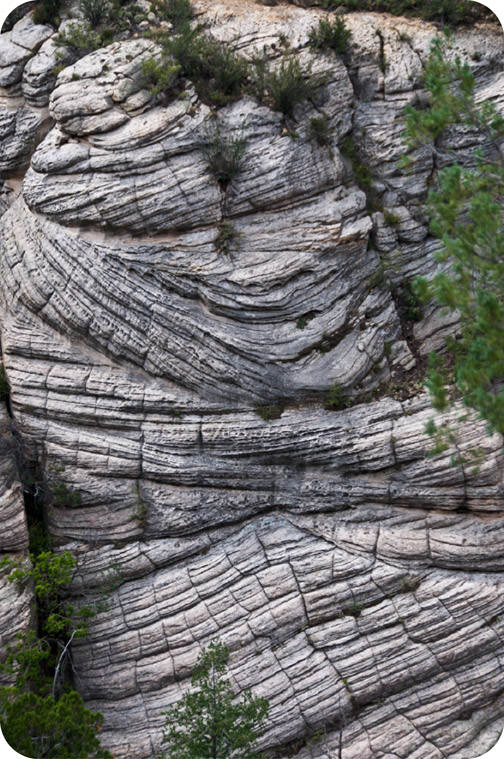
Walnut Canyon, just outside Flagstaff, Arizona, is a high desert landscape displaying cliff dwellings built 700 years ago by a long gone people. On the opposite side from the trail around the mesa is this incredible rock. In this rock you can see that the rock has slumped, and also see signs of mechanical weathering (fractures) and chemical weathering (dissolution). If you get a chance, go see the rock (and the cliff dwellings) for yourself.
Weathering
Weathering is the process that changes solid rock into sediments. Sediments were described in the chapter "Materials of Earth's Crust." With weathering, rock is disintegrated. It breaks into pieces. Once these sediments are separated from the rocks, erosion is the process that moves the sediments.
While plate tectonics forces work to build huge mountains and other landscapes, the forces of weathering gradually wear those rocks and landscapes away. Together with erosion, tall mountains turn into hills and even plains. The Appalachian Mountains along the east coast of North America were once as tall as the Himalayas.
Weathering Takes Time
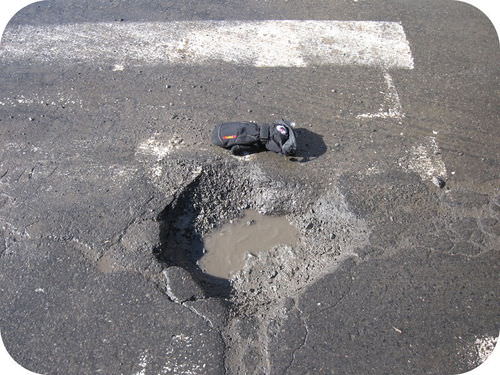
No human being can watch for millions of years as mountains are built, nor can anyone watch as those same mountains gradually are worn away. But imagine a new sidewalk or road. The new road is smooth and even. Over hundreds of years, it will completely disappear, but what happens over one year? What changes would you see? (Figurebelow). What forces of weathering wear down that road, or rocks or mountains over time?
A once smooth road surface has cracks and fractures, plus a large pothole.
Summary
Weathering breaks down Earth materials into smaller pieces.
Erosion transports those pieces to other locations.
Weathering and erosion modify Earth's surface landscapes over time.
Review
What is weathering?
How is weathering different from erosion?
Why does weathering take so much time?
Vocabulary
termdefinition
weatheringthe chemical or physical breakdown of rocks, soils or minerals at Earth's surface.
Notes/Highlights
Color
Highlighted Text
Notes
Please Sign In to create your own Highlights / Notes


 FlexiA FREE Digital Tutor for Every Student
 FlexBooks 2.0Customizable, digital textbooks in a new, interactive platform
 FlexBooksCustomizable, digital textbooks
 SchoolsFlexBooks from schools and districts near you
 Study GuidesQuick review with key information for each concept
 Adaptive PracticeBuilding knowledge at each student’s skill level
 SimulationsInteractive Physics & Chemistry Simulations
 PLIXPlay. Learn. Interact. eXplore.
 CCSS MathConcepts and FlexBooks aligned to Common Core
 NGSSConcepts aligned to Next Generation Science Standards
 Certified EducatorStand out as an educator. Become CK-12 Certified.
 WebinarsLive and archived sessions to learn about CK-12