In extreme environments, where there is little moisture and soil development, it's possible to see rocks that have broken by mechanical weathering. This talus in Colorado's Indian Peaks broke from the jointed rock that is exposed.
Mechanical Weathering
Mechanical weathering (also called physical weathering) breaks rock into smaller pieces. These smaller pieces are just like the bigger rock, but smaller. That means the rock has changed physically without changing its composition. The smaller pieces have the same minerals, in just the same proportions as the original rock.
Ice Wedging
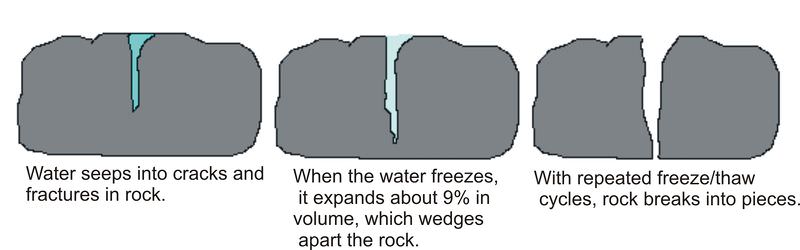
There are many ways that rocks can be broken apart into smaller pieces. Ice wedging is the main form of mechanical weathering in any climate that regularly cycles above and below the freezing point (Figurebelow). Ice wedging works quickly, breaking apart rocks in areas with temperatures that cycle above and below freezing in the day and night, and also that cycle above and below freezing with the seasons.
Ice wedging.
Ice wedging breaks apart so much rock that large piles of broken rock are seen at the base of a hillside, as rock fragments separate and tumble down. Ice wedging is common in Earth’s polar regions and mid latitudes, and also at higher elevations, such as in the mountains.
Abrasion
Abrasion is another form of mechanical weathering. In abrasion, one rock bumps against another rock.
Gravity causes abrasion as a rock tumbles down a mountainside or cliff.
Moving water causes abrasion as particles in the water collide and bump against one another.
Strong winds carrying pieces of sand can sandblast surfaces.
Ice in glaciers carries many bits and pieces of rock. Rocks embedded at the bottom of the glacier scrape against the rocks below.
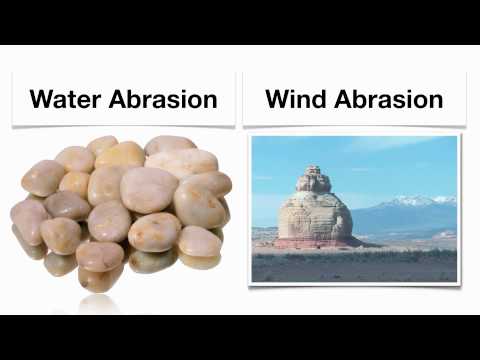
Abrasion makes rocks with sharp or jagged edges smooth and round. If you have ever collected beach glass or cobbles from a stream, you have witnessed the work of abrasion (Figurebelow).
Rocks on a beach are worn down by abrasion as passing waves cause them to strike each other.
Organisms
Now that you know what mechanical weathering is, can you think of other ways it could happen? Plants and animals can do the work of mechanical weathering (Figurebelow). This could happen slowly as a plant’s roots grow into a crack or fracture in rock and gradually grow larger, wedging open the crack. Burrowing animals can also break apart rock as they dig for food or to make living spaces for themselves.
Humans
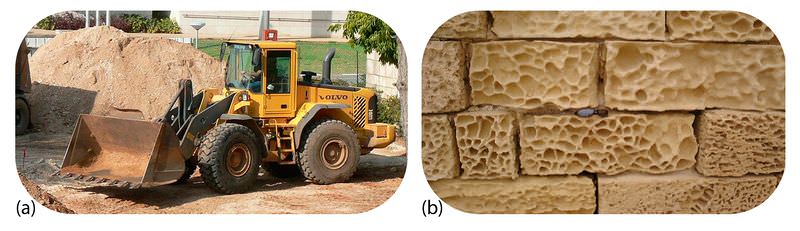
Human activities are responsible for enormous amounts of mechanical weathering, by digging or blasting into rock to build homes, roads, and subways, or to quarry stone.
(a) Humans are tremendous agents of mechanical weathering. (b) Salt weathering of building stone on the island of Gozo, Malta.
Summary
Mechanical weathering breaks down existing rocks and minerals without changing them chemically.
Ice wedging, abrasion, and some actions of living organisms and humans are some of the agents of mechanical weathering.
Review
Describe the process of ice wedging.
Describe the process of abrasion.
How do plants and animals cause mechanical weathering?
Explore More
Use the resource below to answer the questions that follow.
What is weathering?
What are the agents of weathering?
Will physical weathering increase or decrease if a rock is broken into smaller rocks and why?
What is mechanical weathering?
Explain frost wedging.
Explain root wedging.
What is abrasion?
Explain the two types of abrasion.
What is exfoliation? What is it unique to?
What is differential weathering? What can be created with differential weathering?
What role does climate play in physical weathering?
Vocabulary
termdefinition
abrasiona form of mechanical weathering that occurs whenever one rock hits another; this also occurs with glaciers as they scrape underlying rock.
ice wedgingform of mechanical weathering where water enters a crack, expands as it freezes, and wedges the rock apart.
mechanical weatheringweathering that breaks rocks into smaller pieces without altering their chemical composition.
Notes/Highlights
Color
Highlighted Text
Notes
Please Sign In to create your own Highlights / Notes


 FlexiA FREE Digital Tutor for Every Student
 FlexBooks 2.0Customizable, digital textbooks in a new, interactive platform
 FlexBooksCustomizable, digital textbooks
 SchoolsFlexBooks from schools and districts near you
 Study GuidesQuick review with key information for each concept
 Adaptive PracticeBuilding knowledge at each student’s skill level
 SimulationsInteractive Physics & Chemistry Simulations
 PLIXPlay. Learn. Interact. eXplore.
 CCSS MathConcepts and FlexBooks aligned to Common Core
 NGSSConcepts aligned to Next Generation Science Standards
 Certified EducatorStand out as an educator. Become CK-12 Certified.
 WebinarsLive and archived sessions to learn about CK-12