9.10Landforms from Groundwater Erosion and Deposition
Difficulty Level: At Grade | Created by: CK-12
Last Modified: Aug 02, 2016
Loading...
How would you find an undiscovered cave?
Caves may be beneath your feet, especially if your feet are on limestone. In 1974 two amateur cavers found warm, moist air coming out of a crack in the ground in southern Arizona. They managed to find a way in and discovered the amazing Kartchner Caverns, 2.5 miles of pristine caves. You can see these spectacular caverns on a guided tour.
Groundwater Erosion
Rainwater absorbs carbon dioxide (CO2) as it falls. The CO2 combines with water to form carbonic acid. The slightly acidic water sinks into the ground and moves through pore spaces in soil and cracks and fractures in rock. The flow of water underground is groundwater. Groundwater is described further in the chapter Water on Earth.
When water sinks into the ground, it becomes groundwater.
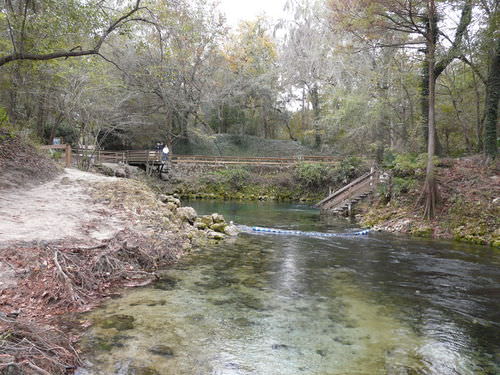
Groundwater is a strong erosional force, as it works to dissolve away solid rock (Figureabove). Carbonic acid is especially good at dissolving the rock limestone.
Cave Formation
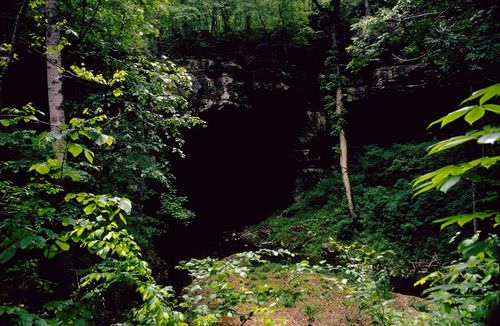
Working slowly over many years, groundwater travels along small cracks. The water dissolves and carries away the solid rock, gradually enlarging the cracks. Eventually, a cave may form (Figurebelow).
Water flows through Russell Cave National Monument in Alabama.
Sinkholes
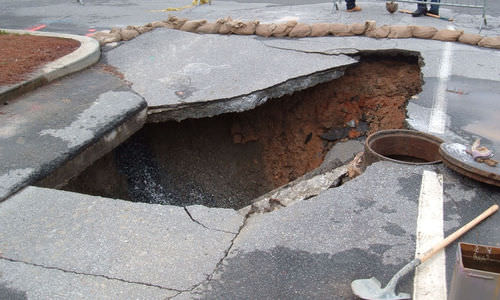
If the roof of a cave collapses, a sinkhole could form. Some sinkholes are large enough to swallow up a home or several homes in a neighborhood (Figurebelow).
A relatively small sinkhole in a Georgia parking lot.
Groundwater Deposition
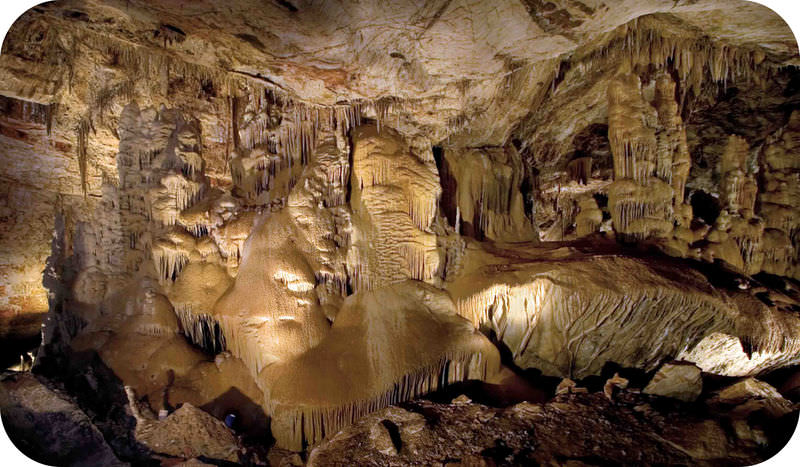
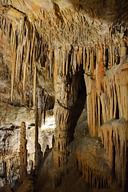
Groundwater carries dissolved minerals in solution. The minerals may then be deposited, for example, as stalagmites or stalactites (Figurebelow). Stalactites form as calcium carbonate drips from the ceiling of a cave, forming beautiful icicle-like formations. The word stalactite has a c, and it forms from the ceiling. Stalagmites form as calcium carbonate drips from the ceiling to the floor of a cave and then grow upwards. The g in stalagmite means it forms on the ground.
Stalactites hang from the ceiling and stalagmites rise from the floor of Carlsbad Caverns in New Mexico. The large stalagmite on the right is almost tall enough to reach the ceiling (or a stalactite) and form a column.
If a stalactite and stalagmite join together, they form a column. One of the wonders of visiting a cave is to witness the beauty of these amazing and strangely captivating structures. Some of the largest, and most beautiful, natural crystals can be found in the Naica mine, in Mexico. These gypsum crystals were formed over thousands of years as groundwater, rich in calcium and sulfur flowed through an underground cave. Check it out:
Summary
Groundwater dissolves minerals, carries the ions in solution, and then deposits them.
Groundwater erodes rock beneath the ground surface, especially carbonate rock.
Groundwater deposits material in caves to create stalactites, stalagmites, and columns.
Review
How does groundwater erode rock material?
Describe how groundwater deposits stalactites and stalagmites.
Why is groundwater acidic?
Explore More
Use this resource to answer the questions that follow.
What rock type is the cave system formed in?
What was the source of the acid in the water that carved the cave?
Why are the rooms large at Carlsbad compared to most other caves?
What cave formations can be seen at Carlsbad? How do they form?
How does water form in and out of the caves?
What biological wonders are found at Carlsbad?
Vocabulary
termdefinition
columnsolid cave feature formed when a stalactite and a stalagmite grow together.
groundwaterwater that exists in the ground either in the soil or in rock layers below the surface.
sinkholecircular hole in the ground that forms as the roof of a cave collapses.
stalactiteicicle-like formation of calcium carbonate from water dripping from the ceiling of a cave.
stalagmitedeposit of calcium carbonate that grows upward in caves as water drips onto the floor.
Notes/Highlights
Color
Highlighted Text
Notes
Please Sign In to create your own Highlights / Notes
 AI Teacher Tools

 FlexiA FREE Digital Tutor for Every Student
 FlexBooks 2.0Customizable, digital textbooks in a new, interactive platform
 FlexBooksCustomizable, digital textbooks
 SchoolsFlexBooks from schools and districts near you
 Study GuidesQuick review with key information for each concept
 Adaptive PracticeBuilding knowledge at each student’s skill level
 SimulationsInteractive Physics & Chemistry Simulations
 PLIXPlay. Learn. Interact. eXplore.
 CCSS MathConcepts and FlexBooks aligned to Common Core
 NGSSConcepts aligned to Next Generation Science Standards
 Certified EducatorStand out as an educator. Become CK-12 Certified.
 WebinarsLive and archived sessions to learn about CK-12