Did you ever plant a garden? Even if you live in an area with poor soil you can buy some dirt and put in some seeds. The type of soil that forms in an area depends on many factors. Some regions produce soil that are not good for crops, but may be good for something else, like cactus!
Soil Formation
How well soil forms and what type of soil forms depends on several different factors, which are described below.
Climate
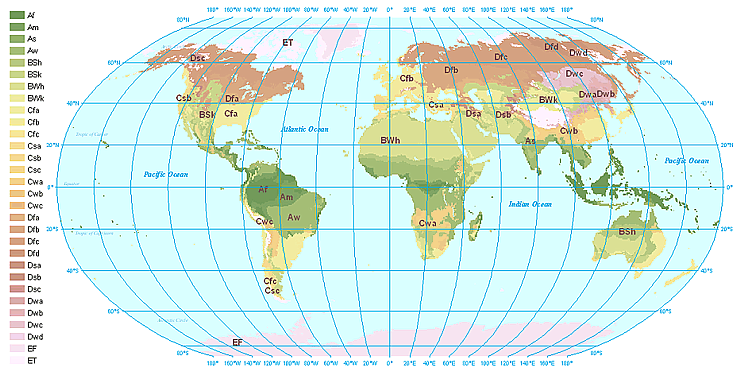
Scientists know that climate is the most important factor determining soil type because, given enough time, different rock types in a given climate will produce a similar soil (Figurebelow). Even the same rock type in different climates will not produce the same type of soil. This is true because most rocks on Earth are made of the same eight elements and when the rock breaks down to become soil, those elements dominate.
Climate is the most important factor in determining the type of soil that will form in a particular area.
The same factors that lead to increased weathering also lead to greater soil formation.
More rain equals more chemical reactions to weatherminerals and rocks. Those reactions are most efficient in the top layers of the soil, where the water is fresh and has not yet reacted with other materials.
Increased rainfall increases the amount of rock that is dissolved as well as the amount of material that is carried away by moving water. As materials are carried away, new surfaces are exposed, which also increases the rate of weathering.
Increased temperature increases the rate of chemical reactions, which also increases soil formation.
In warmer regions, plants and bacteria grow faster, which helps to weather material and produce soils. In tropical regions, where temperature and precipitation are consistently high, thick soils form. Arid regions have thin soils.
Soil type also influences the type of vegetation that can grow in the region. We can identify climate types by the types of plants that grow there.
Rock Type
The original rock is the source of the inorganic portion of the soil. The minerals that are present in the rock determine the composition of the material that is available to make soil. Soils may form in place or from material that has been moved.
Residual soils form in place. The underlying rock breaks down to form the layers of soil that reside above it. Only about one-third of the soils in the United States are residual.
Transported soils have been transported in from somewhere else. Sediments can be transported into an area by glaciers, wind, water, or gravity. Soils form from the loose particles that have been transported to a new location and deposited.
Slope
The steeper the slope, the less likely material will be able to stay in place to form soil. Material on a steep slope is likely to go downhill. Materials will accumulate and soil will form where land areas are flat or gently undulating.
Time
Soils thicken as the amount of time available for weathering increases. The longer the amount of time that soil remains in a particular area, the greater the degree of alteration.
Biological Activity
The partial decay of plant material and animal remains produces the organic material and nutrients in soil. In soil, decomposing organisms breakdown the complex organic molecules of plant matter and animal remains to form simpler inorganic molecules that are soluble in water. Decomposing organisms also create organic acids that increase the rate of weathering and soil formation. Bacteria in the soil change atmospheric nitrogen into nitrates.
The decayed remains of plant and animal life are called humus, which is an extremely important part of the soil. Humus coats the mineral grains. It binds them together into clumps that then hold the soil together, creating its structure. Humus increases the soil’s porosity and water-holding capacity and helps to buffer rapid changes in soil acidity. Humus also helps the soil to hold its nutrients, increasing its fertility. Fertile soils are rich in nitrogen, contain a high percentage of organic materials, and are usually black or dark brown in color. Soils that are nitrogen poor and low in organic material might be gray or yellow or even red in color. Fertile soils are more easily cultivated.
Summary
The factors that affect soil formation are climate, rock type, slope, time, and biological activity. Differences in these factors will produce different types of soil.
Soil type determines what can grow in a region.
Humus, the decayed remains of living organisms, is essential for soils to be fertile.
Review
How does climate affect soil type? Why is climate the most important factor in developing the characteristics of a soil?
How does time affect soil formation in an arid environment versus in a warm, humid environment?
What is the role of partially decayed plant and animal remains in a soil?
Explore More
Use the resource below to answer the questions that follow.
Which chemical property most contributes to soil formation and what effects does it have?
Which physical properties most contributes to soil formation and what effect does it have?
How does relief affect soil formation?
What do the scientists say is the succession that occurs in soil development?
How does the slope that has been deglaciated for 50 years differ from the nearby slope that has been glacier free for thousands of years?
How does agricultural development affect the timing of soil formation?
Why do scientists who study soils need a new set of terms to describe soils?
Vocabulary
termdefinition
humusthe partially decayed remains of plants and animals; forms the organic portion of soil.
residual soilsoil that forms from the bedrock upon which it lies.
transported soilsoil that forms from weathered components transported to a different area.
Notes/Highlights
Color
Highlighted Text
Notes
Please Sign In to create your own Highlights / Notes


 FlexiA FREE Digital Tutor for Every Student
 FlexBooks 2.0Customizable, digital textbooks in a new, interactive platform
 FlexBooksCustomizable, digital textbooks
 SchoolsFlexBooks from schools and districts near you
 Study GuidesQuick review with key information for each concept
 Adaptive PracticeBuilding knowledge at each student’s skill level
 SimulationsInteractive Physics & Chemistry Simulations
 PLIXPlay. Learn. Interact. eXplore.
 CCSS MathConcepts and FlexBooks aligned to Common Core
 NGSSConcepts aligned to Next Generation Science Standards
 Certified EducatorStand out as an educator. Become CK-12 Certified.
 WebinarsLive and archived sessions to learn about CK-12