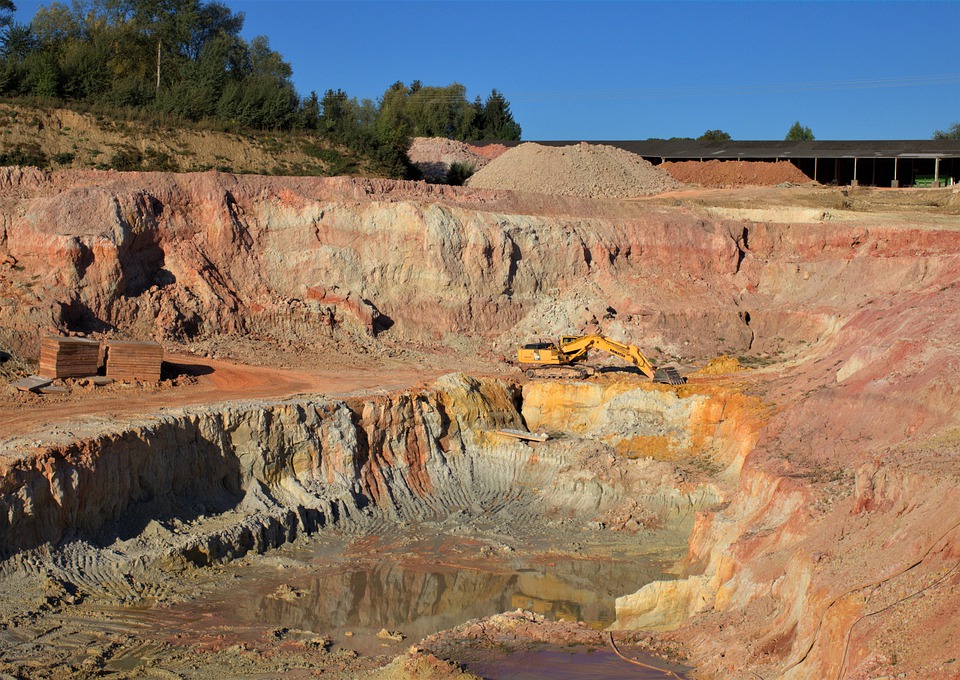
Soils are so different. In the desert there's a very thin layer and then bedrock. The quarry in the photo is of clay. A thick, thick layer of clay is found in this area. The area must be quite moist for so much rock material to have weathered to clays.
Soil Horizons and Profiles
A residual soil forms over many years, as mechanical and chemical weathering slowly change solid rock into soil. The development of a residual soil may go something like this.
The bedrock fractures because of weathering from ice wedging or another physical process.
Water, oxygen, and carbon dioxide seep into the cracks to cause chemical weathering.
Plants, such as lichens or grasses, become established and produce biological weathering.
Weathered material collects until there is soil.
The soil develops soil horizons, as each layer becomes progressively altered. The greatest degree of weathering is in the top layer. Each successive, lower layer is altered just a little bit less. This is because the first place where water and air come in contact with the soil is at the top.
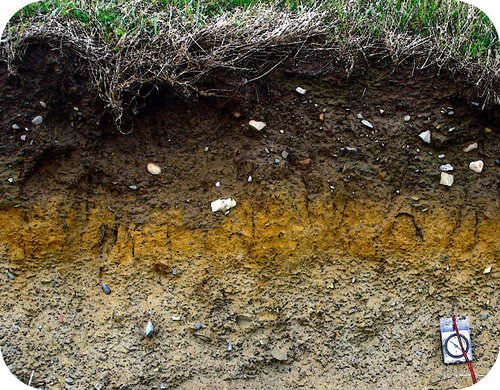
A cut in the side of a hillside shows each of the different layers of soil. All together, these are called a soil profile (Figurebelow).
Soil is an important resource. Each soil horizon is distinctly visible in this photograph.
The simplest soils have three horizons.
Topsoil
Called the A-horizon, the topsoil is usually the darkest layer of the soil because it has the highest proportion of organic material. The topsoil is the region of most intense biological activity: insects, worms, and other animals burrow through it and plants stretch their roots down into it. Plant roots help to hold this layer of soil in place.
In the topsoil, minerals may dissolve in the fresh water that moves through it to be carried to lower layers of the soil. Very small particles, such as clay, may also get carried to lower layers as water seeps down into the ground.
Subsoil
The B-horizon or subsoil is where soluble minerals and clays accumulate. This layer is lighter brown and holds more water than the topsoil because of the presence of iron and clay minerals. There is less organic material. Figurebelow.
A soil profile is the complete set of soil layers. Each layer is called a horizon.
C horizon
The C-horizon is a layer of partially altered bedrock. There is some evidence of weathering in this layer, but pieces of the original rock are seen and can be identified.
Not all climate regions develop soils, and not all regions develop the same horizons. Some areas develop as many as five or six distinct layers, while others develop only very thin soils or perhaps no soils at all.
Summary
Soil horizons are layers within a soil showing different amounts of alteration.
Soil profiles show the layers of soil, which include topsoil, subsoil and the C horizon.
Topsoil has the highest proportion of organic material and is very important for agriculture.
Review
Describe topsoil. Why is loss of topsoil a very large problem when it happens?
Describe the weathering processes that go into producing soil.
What is the C horizon?
Explore More
Use this resource to answer the questions that follow.
What creates soil horizons?
What is a soil profile?
What is the O horizon made of?
What are the characteristics of the A horizon?
What are the characteristics of the E horizon?
What are the characteristics of the B horizon?
What are the characteristics of the C horizon?
Vocabulary
termdefinition
C-horizonthe lowest layer of soil; partially altered bedrock.
soil horizonan individual layer of a complete soil profile; examples include A, B & C horizons.
soil profilethe entire set of soil layers or horizons for a particular soil.
Notes/Highlights
Color
Highlighted Text
Notes
Please Sign In to create your own Highlights / Notes


 FlexiA FREE Digital Tutor for Every Student
 FlexBooks 2.0Customizable, digital textbooks in a new, interactive platform
 FlexBooksCustomizable, digital textbooks
 SchoolsFlexBooks from schools and districts near you
 Study GuidesQuick review with key information for each concept
 Adaptive PracticeBuilding knowledge at each student’s skill level
 SimulationsInteractive Physics & Chemistry Simulations
 PLIXPlay. Learn. Interact. eXplore.
 CCSS MathConcepts and FlexBooks aligned to Common Core
 NGSSConcepts aligned to Next Generation Science Standards
 Certified EducatorStand out as an educator. Become CK-12 Certified.
 WebinarsLive and archived sessions to learn about CK-12