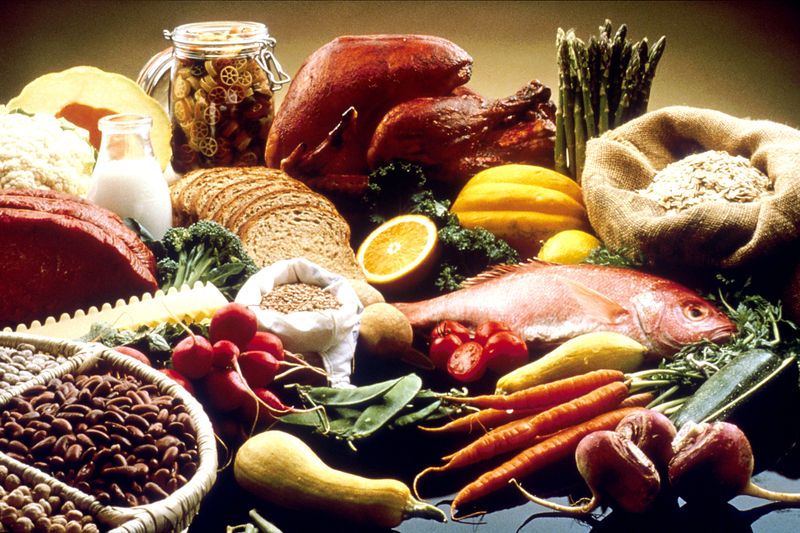
This concept is a series of four videos discussing nutrition and the digestive system. Each video link is followed by a set of questions related to the video. Read the questions prior to watching the video. Think about the questions as you watch the video, and/or answer the questions after watching the video.
absorption: Process that allows nutrients to be taken up by the blood.
amino acid: Small molecule used to build proteins.
calorie: The approximate amount of energy needed to raise the temperature of one gram of water by one degree Celsius.
carbohydrate: Organic compound, such as sugar and starch, that provides an energy source for animals.
chemical digestion: Process by which large food molecules are broken down into small nutrient molecules through a chemical process.
digestive system: Body system that breaks down food, absorbs nutrients, and rids the body of solid food waste.
fiber: Carbohydrate that is partially indigestible.
lipid: Organic compound that is insoluble in water and includes fats, oils, and waxes.
mechanical digestion: Process by which large chunks of food are broken down into small pieces through a physical process, such as chewing.
mineral: Chemical element, such as calcium or potassium, that is needed for body processes.
nutrient: Chemical in food that your body needs.
peristalsis: Muscle contractions that help food move through the digestive system.
protein: Organic compound composed of amino acids and includes enzymes, antibodies, and muscle fibers.
vitamin: Organic compound needed in small amounts for the body to function properly.
Summary
The body needs water and energy to survive.
Energy comes from carbohydrates, proteins and fats that are eaten.
Energy is expressed in calories. The average eighth grade student needs 2,000C each day.
Sugars are simple carbohydrates. Simple carbohydrates provide quick energy.
Starch is a complex carbohydrate. They provide longer lasting energy.
Fats provide up to twice the energy of other nutrients.
Bad fats can be very unhealthy.
Proteins are the building blocks of life.
Some amino acids must come from food.
Water provides many essential functions in the body.
Vitamins and minerals are necessary for the body to function optimally.
The digestive system breaks down food, absorbs nutrients, and excretes waste.
Review
"You are what you eat." What is meant by this phase?
What is a nutrient?
What are carbohydrates, proteins and fats?
Why are unsaturated fats better than saturated fats?
Why are vitamins and minerals important?
Describe the main organs of the digestive function.
Notes/Highlights
Color
Highlighted Text
Notes
Please Sign In to create your own Highlights / Notes
Currently there are no resources to be displayed.
Description
Healthy Literacy for Teens is a middle school resource developed by Stanford University and donated to CK-12 Foundation. This FlexBook is intended to teach teenagers about their bodies and ways to maintain a healthy lifestyle. It complements and supplements CK-12's Life Science Concepts and has been aligned with CK-12 Life Science and Biology Concepts. Check out CK-12 concepts for additional information on these important topics.


 FlexiA FREE Digital Tutor for Every Student
 FlexBooks 2.0Customizable, digital textbooks in a new, interactive platform
 FlexBooksCustomizable, digital textbooks
 SchoolsFlexBooks from schools and districts near you
 Study GuidesQuick review with key information for each concept
 Adaptive PracticeBuilding knowledge at each student’s skill level
 SimulationsInteractive Physics & Chemistry Simulations
 PLIXPlay. Learn. Interact. eXplore.
 CCSS MathConcepts and FlexBooks aligned to Common Core
 NGSSConcepts aligned to Next Generation Science Standards
 Certified EducatorStand out as an educator. Become CK-12 Certified.
 WebinarsLive and archived sessions to learn about CK-12