




Three times Aubrey's age minus twice Dakar's age is less than or equal to 25. Four times Aubrey's age plus three times Dakar's age is greater than or equal to 90. Which could be their ages?
A. Aubrey is 10 and Dakar is 15.
B. Aubrey is 16 and Dakar is 8.
C. Aubrey is 17 and Dakar is 13.
Solutions to a System of Linear Inequalities
A linear system of inequalities has an infinite number of solutions. Recall that when graphing a linear inequality the solution is a shaded region of the graph which contains all the possible solutions to the inequality. In a system, there are two linear inequalities. The solution to the system is all the points that satisfy both inequalities or the region in which the shading overlaps.
Given the system of linear inequalities shown in the graph, let's determine which points are solutions to the system.

(0, -1)
The point (0, -1) is not a solution to the system of linear inequalities. It is a solution to (graphed in ), but it lies on the line which is not included in the solution to (shown in ). The point must satisfy both inequalities to be a solution to the system.
(2, 3)
The point (2, 3) lies in the overlapping shaded region and therefore is a solution to the system.
(-2, -1)
The point (-2, -1) lies outside the overlapping shaded region and therefore is not a solution the system.
(3, 5)
The point (3, 5) lies on the line , which is included in the solution to . Since this part of the line is included in the solution to , it is a solution to the system.
Let's determine whether the following points are solutions to the system of linear inequalities:
This time we do not have a graph with which to work. Instead, we will plug the points into the equations to determine whether or not they satisfy the linear inequalities. A point must satisfy both linear inequalities to be a solution to the system.
(3, 1)
Yes, and are both valid inequalities. Therefore, (3, 1) is a solution to the system.
(1, 2)
No, is true, but , so the point fails the second inequality.
(5, 2)
No, is true, but , so the point fails the second inequality.
(-3, 1)
No, , so the point fails the first inequality. There is no need to check the point in the second inequality since it must satisfy both to be a solution.
Now, let's answer the following question.
Is (-9, 0) a solution to the system below?
Substitute the point into each equation and see if the inequalities hold true.
The first inequality is true, let's test the second.
This inequality is also true, therefore (-9, 0) is a solution.
Examples
Example 1
Earlier, you were asked to find Aubrey's and Dakar's ages.
We don't have a graph to work with so we must plug the ages into the system of inequalities to determine whether or not they satisfy both. The system of linear inequalities represented by this situation is:
Now we test each of the possibilities.
For A = 10 and D = 15: is fulfilled. is NOT fulfilled.
For B = 16 and D = 8: is NOT fulfilled and we can stop here.
For B = 17 and D = 13: is fulfilled. is fulfilled.
Therefore, of the answer choices given only C could be Aubrey and Dakar's ages.
Example 2
Determine whether the given points are solutions to the systems shown in the graph:
(-3, 3)
(-3, 3) is a solution to the system because it lies in the overlapping shaded region.
(4, 2)
(4, 2) is not a solution to the system. It is a solution to the red inequality only.
(3, 2)
(3, 2) is not a solution to the system because it lies on the dashed blue line and therefore does not satisfy that inequality.
(-4, 4)
(-4, 4) is a solution to the system since it lies on the solid red line that borders the overlapping shaded region.

Example 3
Determine whether the following points are solutions to the system:
(4, 0)
Yes, , and .
(0, -5)
No, so the first inequality is not satisfied.
(7, 12)
Yes, , and .
(-1, -3)
No, so the first inequality is not satisfied.
Review
Given the four linear systems graphed below, match the point with the system(s) for which it is a solution.
A. 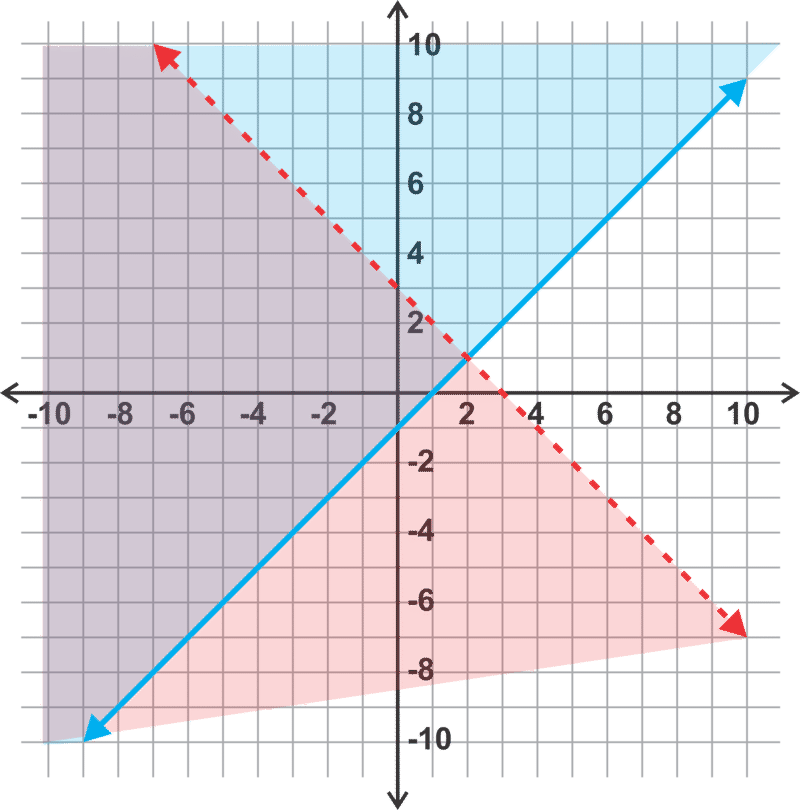
B. 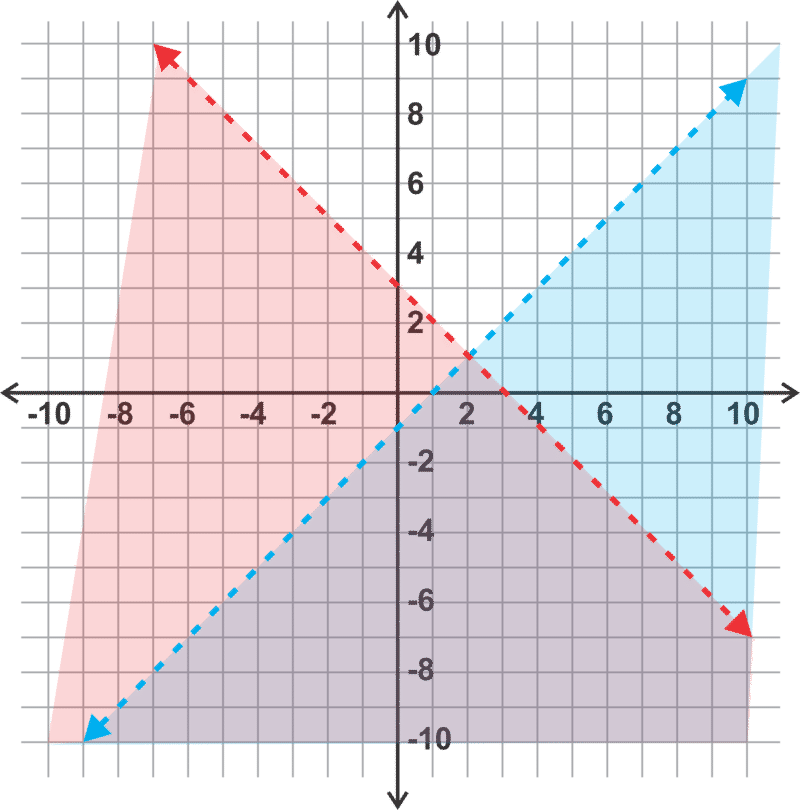
C. 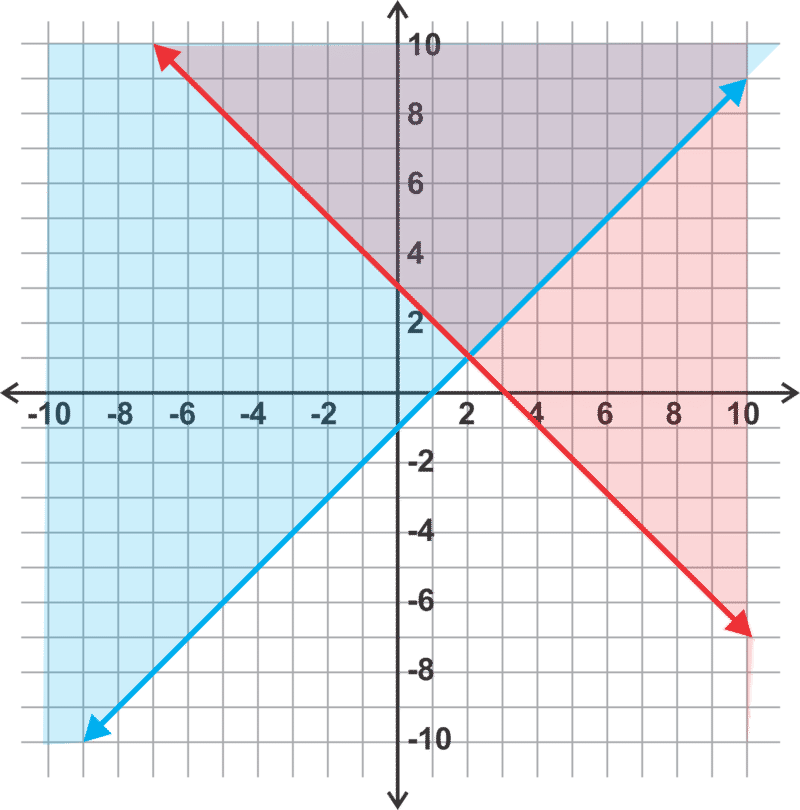
D. 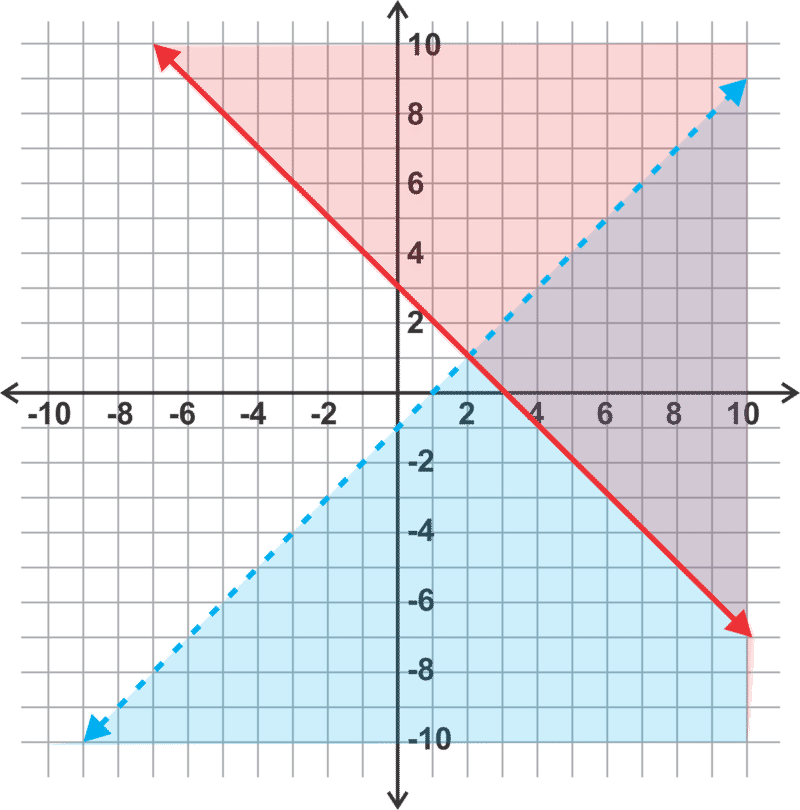
- (0, 3)
- (2, -1)
- (4, 3)
- (-2, 1)
- (-3, 0)
- (4, -1)
- (-1, -2)
- (2, 1)
- (2, 5)
- (0, 0)
Given the four linear systems below, match the point with the system(s) for which it is a solution.
A.
B.
C.
D.
- (0, 0)
- (4, 6)
- (0, 5)
- (-3, 4)
- (4, 3)
- (0, 3)
- (-8, -3)
- (1, 6)
- (4, -5)
- (4, -2)
Review (Answers)
Click HERE to see the answer key or go to the Table of Contents and click on the Answer Key under the 'Other Versions' option.


