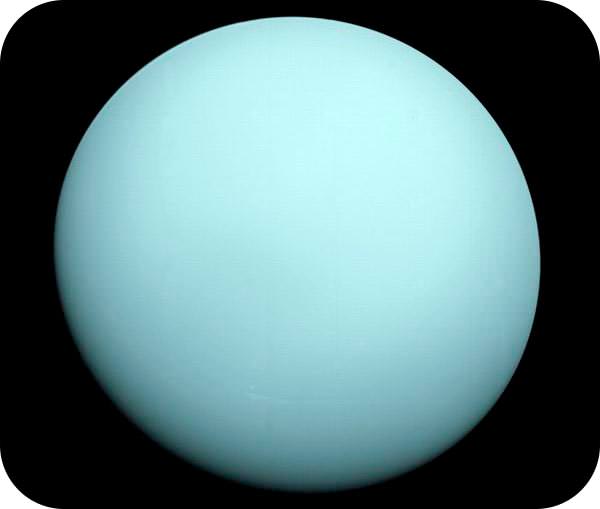
Uranus is an icy blue-green ball named for the ancient Greek god of the heavens. The planet's satellites are named for the characters of Shakespeare and Alexander Pope.
Uranus
Uranus (YOOR-uh-nuhs) is named for the Greek god of the sky. From Earth, Uranus is so faint that it was unnoticed by ancient observers. William Herschel first discovered the planet in 1781.
Although Uranus is very large, it is extremely far away, about 2.8 billion km (1.8 billion mi) from the Sun. Light from the Sun takes about 2 hours and 40 minutes to reach Uranus. Uranus orbits the Sun once about every 84 Earth years.
Uranus has a mass about 14 times the mass of Earth, but it is much less dense than Earth. Gravity at the surface of Uranus is weaker than on Earth’s surface, so if you were at the top of the clouds on Uranus, you would weigh about 10% less than what you weigh on Earth.
An Icy Blue-Green Ball
Like Jupiter and Saturn, Uranus is composed mainly of hydrogen and helium, with an outer gas layer that gives way to liquid on the inside. Uranus has a higher percentage of icy materials, such as water, ammonia (NH3), and methane (CH4), than Jupiter and Saturn.
When sunlight reflects off Uranus, clouds of methane filter out red light, giving the planet a blue-green color. There are bands of clouds in the atmosphere of Uranus, but they are hard to see in normal light, so the planet looks like a plain blue ball.
The Sideways Planet
Most of the planets in the solar system rotate on their axes in the same direction that they move around the Sun. Uranus, though, is tilted on its side, so its axis is almost parallel to its orbit. In other words, it rotates like a top that was turned so that it was spinning parallel to the floor. Scientists think that Uranus was probably knocked over by a collision with another planet-sized object billions of years ago.
Rings and Moons of Uranus
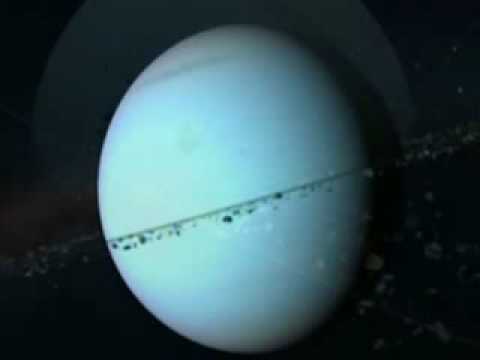
Uranus has a faint system of rings (Figurebelow). The rings circle the planet’s equator, but because Uranus is tilted on its side, the rings are almost perpendicular to the planet’s orbit.
This image from the Hubble Space Telescope shows the faint rings of Uranus. The planet is tilted on its side, so the rings are nearly vertical.
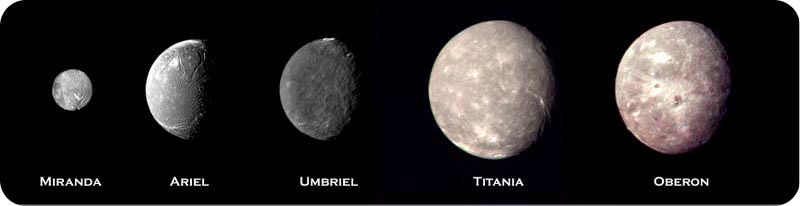
Uranus has 27 known moons and all but a few of them are named for characters from the plays of William Shakespeare. The five biggest moons of Uranus — Miranda, Ariel, Umbriel, Titania, and Oberon — are shown in Figurebelow.
These Voyager 2 photos have been resized to show the relative sizes of the five main moons of Uranus.
Summary
Uranus is composed of hydrogen and helium, but methane clouds filter red light and give the planet a blue-green color.
The rotational axis of Uranus is tilted almost parallel to its orbit.
Uranus has rings that are nearly perpendicular to the planet's orbit.
Review
Why would you weigh only 90% of your Earth weight on Uranus?
Why is Uranus tilted on its side?
Why is Uranus blue?
Notes/Highlights
Color
Highlighted Text
Notes
Please Sign In to create your own Highlights / Notes


 FlexiA FREE Digital Tutor for Every Student
 FlexBooks 2.0Customizable, digital textbooks in a new, interactive platform
 FlexBooksCustomizable, digital textbooks
 SchoolsFlexBooks from schools and districts near you
 Study GuidesQuick review with key information for each concept
 Adaptive PracticeBuilding knowledge at each student’s skill level
 SimulationsInteractive Physics & Chemistry Simulations
 PLIXPlay. Learn. Interact. eXplore.
 CCSS MathConcepts and FlexBooks aligned to Common Core
 NGSSConcepts aligned to Next Generation Science Standards
 Certified EducatorStand out as an educator. Become CK-12 Certified.
 WebinarsLive and archived sessions to learn about CK-12