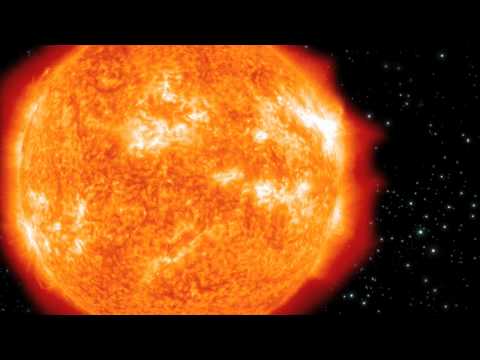
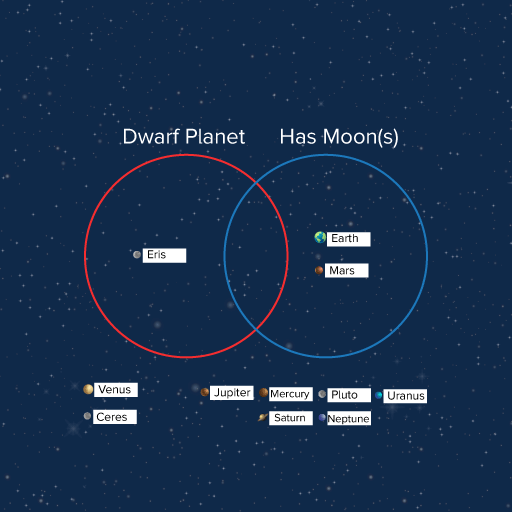
The family includes the Sun, its eight planets (Mercury, Venus, Earth, Mars, Jupiter, Saturn, Uranus, and Neptune), and the five known dwarf planets (Ceres, Pluto, Makemake, Haumea, and Eris). In the image above, relative sizes of the Sun, planets, and dwarf planets and their positions relative to each other are correct, but the relative distances are not.
Eight Planets
Since the time of Copernicus, Kepler, and Galileo, we have learned a lot more about our solar system. Astronomers have discovered two more planets (Uranus and Neptune), five dwarf planets (Ceres, Pluto, Makemake, Haumea, and Eris), more than 150 moons, and many, many asteroids and other small objects.
Although the Sun is just an average star compared to other stars, it is by far the largest object in the solar system. The Sun is more than 500 times the mass of everything else in the solar system combined! Tablebelow gives data on the sizes of the Sun and planets relative to Earth.
Distances in the solar system are often measured in astronomical units (AU). One astronomical unit is defined as the distance from Earth to the Sun. 1 AU equals about 150 million km, or 93 million miles. Tablebelow shows the distances to the planets (the average radius of orbits) in AU. The table also shows how long it takes each planet to spin on its axis (the length of a day) and how long it takes each planet to complete an orbit (the length of a year); in particular, notice how slowly Venus rotates relative to Earth.
Distances to the Planets and Properties of Orbits Relative to Earth's Orbit
Planet
Average Distance from Sun (AU)
Length of Day (In Earth Days)
Length of Year (In Earth Years)
Mercury
0.39 AU
56.84 days
0.24 years
Venus
0.72
243.02
0.62
Earth
1.00
1.00
1.00
Mars
1.52
1.03
1.88
Jupiter
5.20
0.41
11.86
Saturn
9.54
0.43
29.46
Uranus
19.22
0.72
84.01
Neptune
30.06
0.67
164.8
Summary
The planets of the solar system, with increasing distance from the Sun, are Mercury, Venus, Earth, Mars, Jupiter, Saturn, Uranus, and Neptune. The five known dwarf planets are Ceres, Pluto, Makemake, Haumea, and Eris.
Solar system distances are measured as multiples of the distance between Earth and Sun, which is defined as one astronomical unit (AU).
All planets and dwarf planets orbit the Sun and rotate on their axes.
Review
Why does the number of dwarf planets recognized by astronomers in the solar system sometimes increase?
What is the order of planets and dwarf planets by distance from the Sun?
What is an astronomical unit? Why is this unit used to measure distances in the solar system?
Explore More
Use this resource to answer the questions that follow.
How old is our solar system?
How did the planets form?
What are the two main regions of the solar system?
List the inner planets.
List the outer planets.
What are the requirements to be a planet?
Why was Pluto demoted?
What is the Kuiper Belt?
What is the scattered disk?
What is the heliosphere?
Notes/Highlights
Color
Highlighted Text
Notes
Please Sign In to create your own Highlights / Notes


 FlexiA FREE Digital Tutor for Every Student
 FlexBooks 2.0Customizable, digital textbooks in a new, interactive platform
 FlexBooksCustomizable, digital textbooks
 SchoolsFlexBooks from schools and districts near you
 Study GuidesQuick review with key information for each concept
 Adaptive PracticeBuilding knowledge at each student’s skill level
 SimulationsInteractive Physics & Chemistry Simulations
 PLIXPlay. Learn. Interact. eXplore.
 CCSS MathConcepts and FlexBooks aligned to Common Core
 NGSSConcepts aligned to Next Generation Science Standards
 Certified EducatorStand out as an educator. Become CK-12 Certified.
 WebinarsLive and archived sessions to learn about CK-12