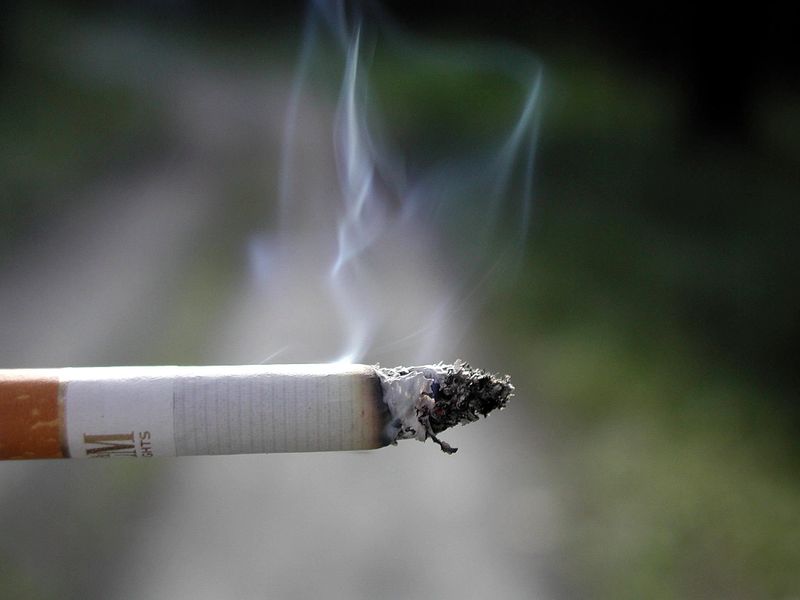
This concept consists of three videos related to tobacco use and smoking. Each video link is followed by a set of questions related to the video. Read the questions prior to watching the video. Think about the questions as you watch the video, and/or answer the questions after watching the video.
alveoli: Tiny sacs in the lungs where gas exchange takes place.
ATP (adenosine triphosphate): Usable form of energy inside the cell.
bronchi: Air passages in the respiratory tract that conduct air into the lungs.
cellular respiration: Process of breaking down glucose to obtain energy in the form of ATP.
hemoglobin: Protein in red blood cells that binds oxygen.
larynx: Respiratory organ between the pharynx and trachea; also called the voice box because it allows the production of vocal sounds.
pharynx: Long, tubular organ that connects the mouth and nasal cavity with the larynx; food and air pass through it.
trachea: Long, tubular organ, also called the wind pipe, that carries air between the larynx and lungs.
Summary
Oxygen is needed by the cells of the body to produce ATP.
Oxygen travels to the body cells through the blood.
Smoking disrupts the amount of oxygen that can travel in the blood.
Smoking damages both the respiratory and cardiovascular systems.
Review
How does oxygen enter the blood?
Why is smoking harmful?
NOTES / HIGHLIGHTS
Please Sign In to create your own Highlights / Notes
Notes/Highlights
Color
Highlighted Text
Notes
Please Sign In to create your own Highlights / Notes
Currently there are no resources to be displayed.
Description
Healthy Literacy for Teens is a middle school resource developed by Stanford University and donated to CK-12 Foundation. This FlexBook is intended to teach teenagers about their bodies and ways to maintain a healthy lifestyle. It complements and supplements CK-12's Life Science Concepts and has been aligned with CK-12 Life Science and Biology Concepts. Check out CK-12 concepts for additional information on these important topics.


 FlexiA FREE Digital Tutor for Every Student
 FlexBooks 2.0Customizable, digital textbooks in a new, interactive platform
 FlexBooksCustomizable, digital textbooks
 SchoolsFlexBooks from schools and districts near you
 Study GuidesQuick review with key information for each concept
 Adaptive PracticeBuilding knowledge at each student’s skill level
 SimulationsInteractive Physics & Chemistry Simulations
 PLIXPlay. Learn. Interact. eXplore.
 CCSS MathConcepts and FlexBooks aligned to Common Core
 NGSSConcepts aligned to Next Generation Science Standards
 Certified EducatorStand out as an educator. Become CK-12 Certified.
 WebinarsLive and archived sessions to learn about CK-12